FATHER JOVICA VUKASOVIĆ HELD A LECTURE IN THE TREASURY OF THE Serbian Orthodox Church (SPC) KOTOR: THE CROSS IS THE CENTER OF OUR LIFE
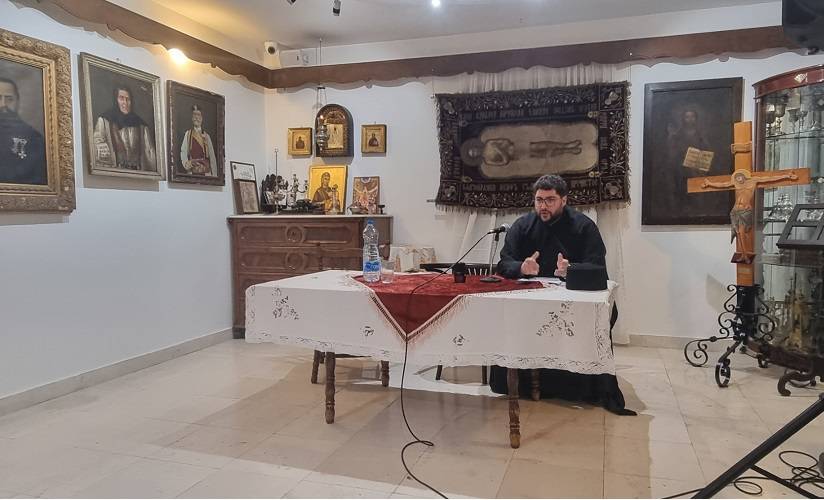
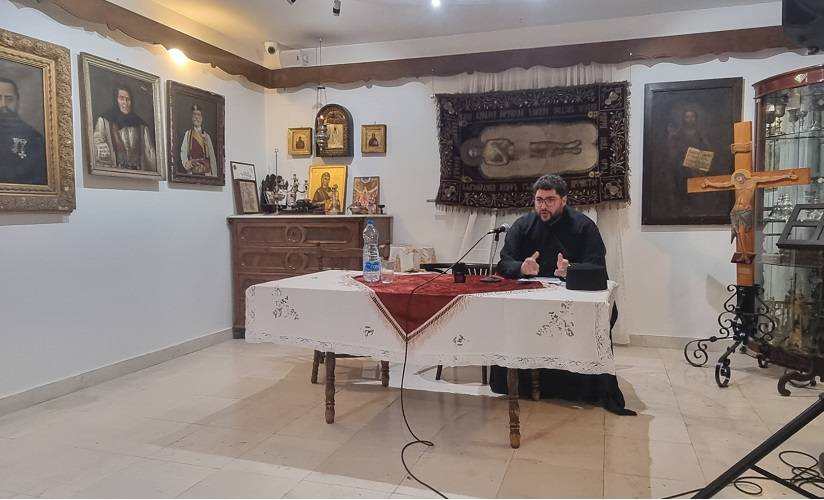
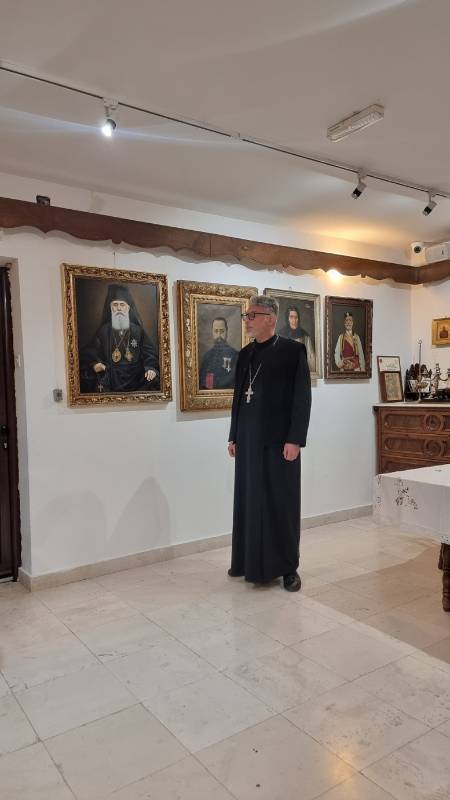
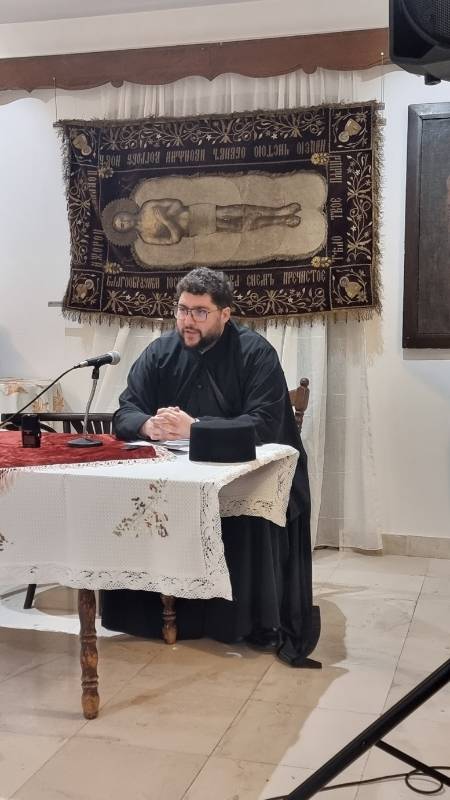
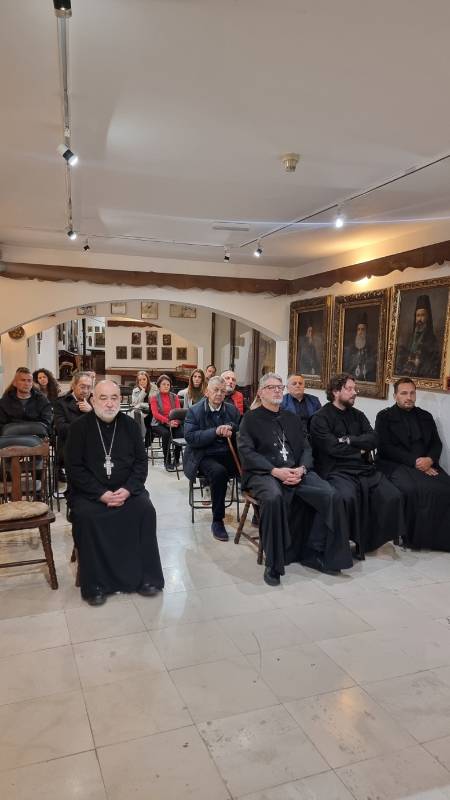
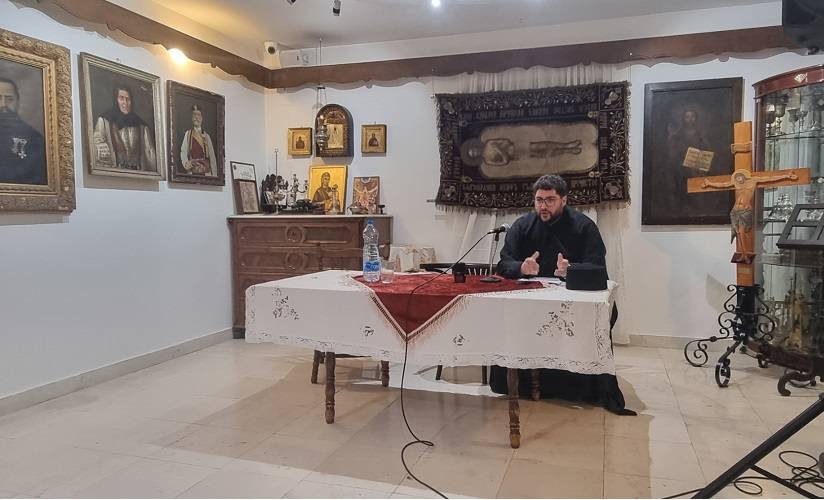
Yesterday, the parish priest of Morinj, Jovica Vukasović, held a lecture entitled "The Significance of the Holy Cross for Easter Lent" in the Treasury of the Serbian Orthodox Church (SPC) Kotor.
The lectures are traditionally held every Thursday during Easter Lent in the Treasury, at the Church of St. Nicholas, and as announced by the hierarchal vicar of Kotor-Tivat, the parish priest of Kotor, Archpriest Stavrophorus Nemanja Krivokapić, welcoming the attendees, the next one will be held by the hierarchal vicar of Podgorica-Kolašin, Archpriest Stavrophorus Gojko Perović.
“In the life of every Christian, or as our people say, everyone who is baptized with the Cross, the Honorable and Life-giving Cross represents the center of our life and accompanies us throughout our entire life. From the moment we become members of the Church, which in our language is beautifully called baptism, until our death, the Cross accompanies us. It is part of our everyday life, part of our prayer. We get up and lie down with it, we go to work with it. We look to it in moments of difficulty, we are shaded by it, and in the end, when we leave this world, when we cease from all works, we are laid in the ground, but under the sign of the Honorable Cross, which is found on the tombstones,” said Fr. Jovica.
He continues with the words that, living by the Cross, we are obliged to portray it and to take it upon ourselves, carry it and bear it according to the words of Christ.
“After the Apostle Peter publicly confessed on the Feast of Tabernacles that Jesus Christ is the Son of God, and after Christ promised him that on him He would build a Church that not even the gates of Hades would prevail, the Lord here for the first time announces to the disciples that the Son of Man is going to Jerusalem, that He will suffer many things, be killed and that after three days He will rise again.
However, the Apostle Peter, inclined to a human understanding of life, not understanding that the Son of Man came into the world for this purpose, says that this will not and cannot be. The Lord then very rudely addresses Peter and says to him, Get behind me, Satan! You are a stumbling block to me, because you do not savour the things that are of God rather than the things that are of men (Matt. 16:23). Then the Lord calls everyone and says If anyone wants to come after me, let him deny himself, and take up his cross, and follow me (Mt, 16:24).
As we can see, taking up the Cross means accepting the call of our Savior. It means voluntarily renouncing oneself and one's desires. It also means abandoning one's bad habits, not keeping them in oneself and not nurturing them. It also means freeing oneself from thoughts, gossip, and judgment. And to distance oneself from sin in a specific way, as the apostle Paul said, to be dead to sin.
Let us not forget that Christ also says that not everyone who says to me, Lord, Lord, will enter the Kingdom of God (Mt. 7:21). Being a Christian does not mean just calling oneself a Christian, it does not mean just being baptized. Being a Christian means being crucified with Christ, bearing the burden upon oneself, in the way that Christ bore it," said Father Jovica.
It also reminds us that Christ was humiliated, rejected, and spat upon on the cross, that His tormented body hung on a tree, nailed to the cross, and that a crown of thorns was placed around His head, but also that at the hour of His death, in agony and suffering, Christ forgives everyone and asks the Father not to count this as sin against them.
“What does this mean for us today? It means that everything that is given to us, be it suffering, illness, poverty, want, insult at work or when some misfortune befalls us, we are obliged to bear it standing, firmly on our feet, without murmuring, without whining or lamenting. Without regret that we are in that situation. Never, not even then, should we envy others, that they are better off than us, because we do not know what kind of cross they are carrying, and what kind of cross has been given to us. Everyone carries the cross according to their own abilities.
Carrying the cross is indeed not easy. It is not easy to suffer. But it is the essence of our life in Christ. In those moments, we have the opportunity to gaze at the Cross of Christ and remember all that He went through for our salvation. Such an image can comfort us and give us the strength to continue.
A church hymn says:
“The Cross of the Lord to those who always worship Him
Is the source of all sweetness and the law of self-control,
For looking continually to Him crucified on Him,
They crucify the flesh with its passions and desires.
And let us be among them,
Through pure fasting, we become related to Him
Who, lovingly suffering, became related to us
And gave us His passionless nature,
And who has great mercy.”
But let us return to the topic of the Cross and fasting. Christians have fasted on Wednesdays and Fridays since the first days. They inherited this fast from the Jews, who fasted on Tuesdays and Thursdays. Early Christians celebrated Easter every Sunday, very solemnly. We can still see this today in the Holy Liturgy. Every Holy Liturgy is a remembrance of everything that “happened for us” on the cross, the tomb, the three-day resurrection, the ascension to Heaven, and the second and glorious coming. Sunday is still dedicated to the Resurrection. That is why the church has designated Wednesday and Friday as days of fasting, because on Wednesday we remember the shameful betrayal of Judas, and on Friday the terrible torment that our Savior suffered when He was crucified on the tree of the cross. In this way, we understand the weekly cycle of worship and the celebration of the resurrection on Sunday more strongly and deeply,” said Jovica.
The fast on Wednesdays and Fridays, he reminds us, is the oldest of all fasts.
“When the apostolic canons speak of fasting before Easter, the 69th canon says that whoever does not fast during the Holy Lent, as on Wednesdays and Fridays, is to be excommunicated from the church. From these words we see that weekly fasting is not only an obligation, but also a necessity for a person in order to live the life of a Christian.
That is why the Church has determined that the third Sunday of Great and Holy Lent should be dedicated to the Holy Cross of the Lord. The third Sunday represents half of the Holy Lent fast.
By Holy Lent we mean the fast from Clean Monday, the first day of Lent, to the Friday before Lazarus Saturday, when the Holy Lent fast ends and we enter Holy Week, the Week of Passion. So, somewhere halfway through Lent, the Holy Cross is placed before us to give us the strength to persevere until the end of Lent. We have already lost the enthusiasm we had at the beginning of Lent. It seemed to us that those fifty days would pass. But that is nothing terrible or unusual. A person struggles with his weaknesses every day. And then, when we are somewhere halfway through our asceticism, the Cross is given to us to remind ourselves, to remember why we fast. Why we actually give up pleasure, enjoyment. Why we consume rather monotonous food, often not very tasty. All this brings us closer to the Cross and the Lord. Whatever our asceticism is. No matter how many times we fall and get up, we must keep one thing in mind. When we finish the Lenten fast, we slowly move with Christ up to Jerusalem. There we will witness the expulsion of the merchants from the temple, we will listen to the story of the fig tree that does not bear fruit, we will attend the dinner at the house of Simon the Leper. We will also witness when a sinful woman anoints the feet of the Teacher with the expensive oil, which was used to anoint the deceased. Christ will also invite us to the Upper Room of Zion to sit at the table with Him and the apostles and be witnesses of the Last Supper. We will also be in Gethsemane when He prays and when the thieves come for Him. We will also be in the courtyard of Caiaphas and Pilate. But what is most important, we will climb with Him to Golgotha and share the suffering that He endures for the sake of our salvation. We will be witnesses of His glorious and three-day Resurrection. And we will remember all this when on Easter, the priest comes out of the altar and with the only lit candle in the entire church and loudly sings Come and receive light from the unfading light and let us glorify Christ who rose from the dead!”, said Fr. Jovica.
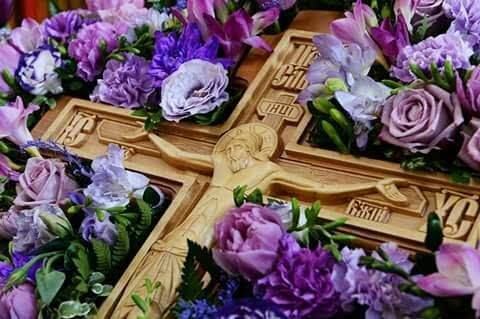
This Sunday after the Great Doxology we will have the opportunity, he continued, to venerate the Holy Cross, when the priests carry it from the Altar.
"For the next seven days, the Holy Cross will stand in the middle of the church and remind all visitors that Easter is near and that there is still time to repent and change your mind. It seems that today we live in a time when the cross is truly viewed as madness, as the Apostle Paul says. It seems to us that today, more than ever, people are bothered by the Holy Cross and that people avert their eyes from it, as if they are afraid of it. Let us just remember how much controversy there was when the cross was returned to classrooms in Italy and Greece.
We know and are witnesses that all hostile forces flee from the sign of the Holy Cross. The impious flee from the Cross, and there is also a popular saying about this, flee like the devil from the cross," said Father Jovica.
He also said that today the question is often asked, why does the Cross bother the world so much today?
"Would it be too cruel to say that the Prince of Darkness has so occupied this world, which is already steeped in evil? When we look at it on a global scale, we can better understand who and why bothers the Cross and our life under the Cross."
A Christian who lives in accordance with the cross is foreign and unacceptable to today's world. A Christian voluntarily fasts, renounces pleasure, fornication, immorality. He voluntarily renounces much that modernity offers for the sake of his salvation.
We voluntarily deny ourselves fatty foods, voluntarily get up early on Sundays and go to the Liturgy, choose to get married and have children. We practice not telling everyone what is on our minds, even when someone offends us or disagrees with us.
All of this is seen today as something primitive, outdated, simply not modern. Modernity calls us to enjoy ourselves, to the right to say what we want, to fight for our rights, freedom of speech, freedom of opinion, beliefs, gender identity and determination. Many concepts such as abstinence, humility, patience, fasting, are unfamiliar to the language of today's man.
Now it is clear to us why the Holy Cross bothers us, because it undoubtedly awakens in every man, believer or unbeliever, the desire and need for man to change.
Simply, a man who gazes at the Holy Cross cannot fail to be touched by His Power. That power constantly calls us to change our lives, to voluntarily accept to deny ourselves and that it is no longer I who lives in us, but that Christ lives in us, as the Apostle Paul says. And I live - no longer I, but Christ lives in me; and the life I now live in the flesh, I live by the faith of the Son of God, who loved me and gave himself for me. (Gal. 2:20)
Let us recall here a wonderful example, touched by the power of the Honorable and Life-giving Cross. Namely, the Fifth Sunday of Lent is dedicated to the former harlot from Alexandria, later the great ascetic of the Jordanian desert, the Venerable Mary of Egypt. As her life says, in her own words, she comes to Jerusalem for fun and enjoyment. Following a group of men, she enters the courtyard of the temple not to pray, but to wait for her customers. And at that very moment, in that courtyard, a historical change takes place. Something happens that will change the history of monasticism and asceticism. She, the Egyptian harlot, went to the temple to see the Cross, since it was the feast of the Exaltation and she could not approach it. She went outside and wept bitterly. At that moment, the Power of the Cross touched her heart, which had been lying in sin until then. She remembered all her sins and decided that it was time to repent and change her mind. And so one of the harlots became one of the greatest ascetics, who lived in the desert for 47 years, feeding on what she found there. Her life and her life are given to us by the Church at the beginning and towards the end of Lent, as a perfect beacon and guide through our life in Christ, through the time of asceticism, fasting and repentance,” said Fr. Jovica.
As he said, this story shows that Christ never leaves us.
“In every suffering, when storms, tempests and unbelief arise, we always have a safe harbor, our Savior. Saint Nicodemus the Athonite tells us that whenever a struggle arises, we kiss the Holy Cross and it will disappear, because with the Cross Christ conquered death and sin.
We must not run away from the Cross, nor be afraid to carry it, because the Cross is the best indicator of freedom. Through the Cross, joy came to the whole world, because for us, having endured the Cross, He destroyed death with death.
Let us not forget that Christ suffered all this for us and for our salvation, but voluntarily. No one forced him to do so. He, as the Son of God, did come into the world to save the world. But, since he was a man, he could also deviate from that. In the Garden of Gethsemane, a struggle is waged with himself. Christ is afraid, he prays that, if possible, this cup may pass from him, but that everything may be according to the will of the Father. But then Christ gets up, and voluntarily surrenders himself to the guards and suffers all the suffering for us and for our sins. Christ voluntarily offers himself to God on the cross and gives us forgiveness of sins and reconciles us with God,” said Fr. Jovica.
Bringing the lecture to an end, he stated that one thing can be concluded from all that has been said - the Cross is not some form, symbol or relic. The Cross is the way of our life and existence in Christ.
"Let us not forget that the Holy Liturgy does not remind us of any miracles from the Life of Christ. We become acquainted with them through the Holy Gospel. The Holy Liturgy reminds us exclusively of the cross and the resurrection of Christ, because it opens up Paradise for us. Miracles are necessary in order for us to believe in Christ, but the Cross is necessary for us to live and exist in Christ.
We will conclude this modest presentation of ours with verses from the evening service, which are sung on Thursday of the Holy Week of the Exaltation of the Cross, which say:
"Your holy Cross, having been deigned to
Joyfully see and kiss,
We pray to you, God, our Savior,
That we may also welcome your most honorable suffering,
Then strengthened by fasting;
Adoring ourselves, let us sing the crucifixion,
The spear, the sponge and the reed
With which you immortalized us,
Into the former sweetness of life again introduced
As a Lover of Man.
Therefore, we now celebrate you with Gratitude,” said Fr. Jovica at a lecture on the significance of the Holy Cross for Easter Lent, held yesterday in the Treasury of the Serbian Orthodox Church of Kotor.
PHOTOS
.png)
RELATED ARTICLES
FATHER JOVICA VUKASOVIĆ HELD A LECTURE IN THE TREASURY OF THE Serbian Orthodox Church...
Yesterday, the parish priest of Morinj, Jovica Vukasović, held a lecture...
The Exaltation of the Cross Sunday – Comfort and Encouragement in the Middle of Lent
On the third Sunday of Great Lent – the Exaltation of the Cross, the...
Calendar for March 13 Venerable Basil the Confessor
He became a monk in his youth and became a disciple of Venerable Procopius the...