
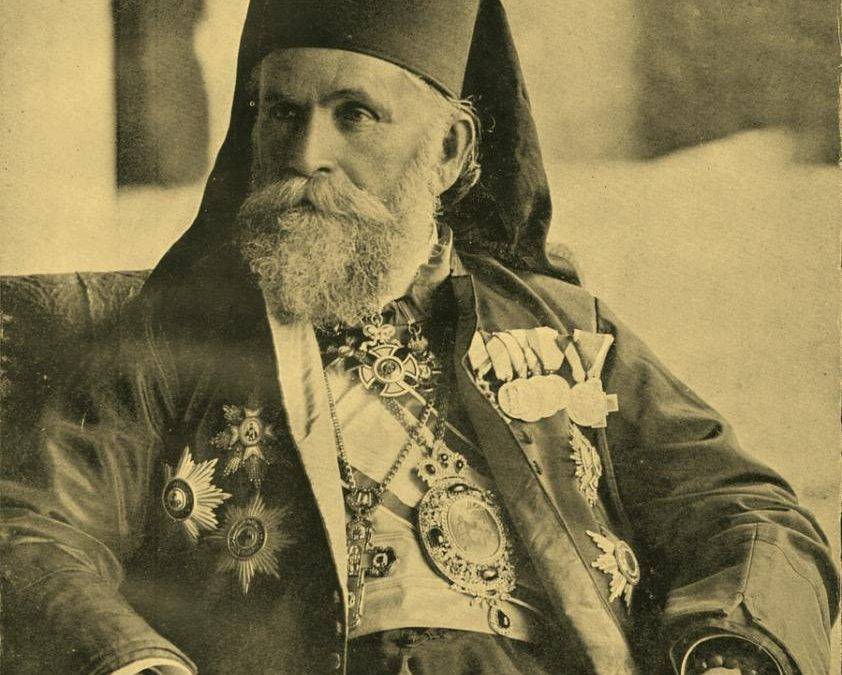
Memory: Mitrofan Ban – Metropolitan of Montenegro, Brda and Primorje (1885–1920)
In memory of Mitrofan Ban – Metropolitan of Montenegro, Brdo and Primorje, who reposed in the Lord on this day in 1920, and was laid to rest in the tomb in the gate of the Cetinje Monastery on October 1, 1920, we would like to remind you of the text by historian Professor Predrag Vukić from the monograph “Cetinje Monastery of the Nativity of the Blessed Virgin Mary 1484–2014”:
The Metropolis of Cetinje during the Time of Metropolitan Mitrofan Ban
On May 27, 1884, Prince Nikola appointed the administrator of the Zahumlje-Raška Eparchy, Archimandrite Mitrofan Ban, to the vacant see of the Metropolis of Cetinje, who took up the see on August 12, 1884, retaining at the same time the administration of the Zahumlje-Raška diocese.
After ascending the throne of the Cetinje Metropolis on March 20, 1885, Archimandrite Mitrofan set off for Petrograd to be consecrated as a bishop there, at the special request of Prince Nikola. The consecration was performed in the St. Isaac's Lavra on April 6, 1885, by Metropolitan Isidore of Petrograd and other members of the Holy Synod, in the presence of the Russian Emperor Alexander III Romanov and members of the Imperial Russian House.
Upon his return to his homeland, Bishop Mitrofan zealously engaged in the administration of his diocese. In the same year, on October 27, Prince Nikola appointed him metropolitan on the occasion of the 25th anniversary of his reign. At the initiative of Metropolitan Mitrofan, Metropolitan Mihailo Jovanović of Belgrade wrote in 1895 a Service to Saint Peter of Cetinje the Wonderworker, which, with the approval of the Russian Holy Synod, was printed in Moscow in the same year at the Synodal Printing House. In this way, Metropolitan Mitrofan sought to further strengthen and establish the cult of Saint Peter of Cetinje, both in church and in, otherwise inseparable, popular life.
Metropolitan Mitrofan continued to implement measures aimed at transforming the status of the clergy, transforming the spiritual life and structure of the Cetinje Metropolis.
Namely, the Cetinje Metropolis had been in an irregular state for centuries due to constant clashes with the Turks, so after the Berlin Congress, the need finally arose to harmonize the church life and organization of the Cetinje Metropolis in Montenegro with the canonical church organization of the other Orthodox Churches.
Metropolitan Mitrofan understood that wearing folk costumes and weapons did not correspond to the priestly rank, so with the approval of the prince, he took measures to ensure that the clergy wore clothes that were appropriate for them. To this end, in 1893, he issued a decree to parish priests and ordered them to replace folk costumes with robes. This order caused considerable disagreement among the priests, because it was not easy for them to give up the old custom, especially since some priests were convinced that this would deprive them of the opportunity to participate in battles and lay down their lives for their homeland, if necessary, as they had done for generations. The disagreement with the aforementioned decision did not last long, and the clergy relatively quickly reconciled themselves to this innovation, realizing that a man could be a patriot even in his robes.
Until 1900, the clergy in Montenegro collected from their parishioners the so-called bir or payment in kind. Each house had to give the priest 18 kg of grain and a certain salary according to the tariff for performing religious rites. This method of collection was in no way good or expedient, especially since the priest himself collected the bir directly from his parishioners, and it happened that he came into conflict with some people as a result. This had a very detrimental effect on both his priestly, teaching and pastoral duties. On the other hand, this was not good for the people themselves, especially in the years of famine, when it was difficult for a family to part with a certain amount of grain, which they often could not even get for money in the markets. That is why Metropolitan Mitrofan, with the approval of Prince Nikola, decided to replace the bir with a monetary surtax, so as to improve the priesthood and make things easier for the people, which was implemented.
This surtax, divided into three classes, according to the wealth of the people, was collected and given to the metropolitan treasury from which the clergy received their salaries. Both the clergy and the people were satisfied with this reform. In addition, at the same time, the Priests' Fund was established to ensure pensions for infirm priests, as well as for the widows and children of deceased priests. The law on this fund and the issuance of pensions from it was written and sanctioned on April 8, 1901. The reform implemented in 1900 was only the beginning in the direction of improving the material condition of the clergy.
… Until the beginning of the 20th century, the Cetinje Metropolis did not have its own spiritual courts. Over time, the need arose to form appropriate spiritual courts, so that the numerous current problems of the Cetinje Metropolis could be more easily resolved. With the aim of forming them, and with the consent of Prince Nikola, Metropolitan Mitrofan turned to the famous canonist Nikodim Milas, Bishop of Zadar, with a request to write the constitutions for the Orthodox consistories and the Holy Synod in Montenegro. Bishop Nikodim responded to the request. When the constitutions were ready, Prince Nikola sanctioned them with his signatures: on December 30, 1903 and January 1, 1904. The Cetinje Consistory began its work in Cetinje on January 2, 1904. The first sessions of the Holy Synod of the Metropolis of Cetinje were held in Cetinje in May 1908. The Nikšić consistory was opened in Nikšić on 2 January 1910.
With the adoption of these laws, the ecclesiastical and legal structure of the Metropolis of Cetinje was finally shaped, so that on the eve of the Balkan Wars it had, for that time, a relatively solid ecclesiastical and legal structure.
In Montenegro, at the turn of the 19th and 20th centuries, priests had a significant reputation. Since Montenegro did not have enough teaching staff, priests would perform the duties of teachers in primary schools throughout the principality until the end of the 19th and the beginning of the 20th centuries, until a sufficient number of teaching staff was formed.
The position of the Metropolis of Cetinje was also regulated in the Constitution of the Principality of Montenegro, which came into force on St. Nicholas Day, 6/19 December 1905. Prince Nikola feared Roman Catholic proselytism and therefore ensured that the same Constitution included protective provisions to protect the Metropolis of Cetinje from proselytism by the Roman Catholic Church. Article 14 of the Constitution literally states: “The Prince and His Household must be of the Eastern Orthodox faith”. Article 40 formally states: “The state religion in Montenegro is Eastern Orthodox. All other recognized religions are free in Montenegro”.
So, as you can see, only the Orthodox faith is guaranteed the status of the state religion in Montenegro. According to Article 45 of the Constitution, the National Assembly consists of deputies elected by the people and deputies appointed by position. In addition to others, deputies by position or as they are also called virile deputies are: the Metropolitan of Cetinje, the Archbishop of Bar and the Mufti of Podgorica. And finally, Article 136 of the Constitution literally states: "Any action directed against the Eastern Orthodox Church in Montenegro (proselytism) is prohibited". So, Prince Nikola really made sure that constitutional and legal norms protect the Orthodox Church from Roman Catholic spiritual aggression. However, Prince Nikola will also make sure that the Metropolis of Cetinje is placed under full state supervision, so that its religious leaders were not able to organize a free spiritual and religious life that would not be under the control of state authorities. In all likelihood, the Cetinje Metropolis was in fact treated by the prince's state authorities more as a state authority and less as a spiritual institution or religious community. This constitutional and legal, but also real, state in which the Cetinje Metropolis found itself would last until the Austro-Hungarian occupation of 1916 and the cessation of Montenegro as an independent state.
As prince and ruler of Montenegro, Nicholas I undoubtedly had a special sense of respect for the Cetinje Monastery and for the person and work of Saint Peter the Wonderworker of Cetinje. Already as a student at the military school in Saint-Cyr in Paris, the future prince of Montenegro would write the poem "The Bell of the Cetinje Monastery" (1859), in which he expressed an extremely sensitive and vivid literary
After the Berlin Congress, the process of settling in the Cetinje Plain began with the inhabitants from the surrounding nahijas, as well as from the hill and Herzegovina tribes, but to a lesser extent. By the charter of Ivan Crnojević, about two-thirds of the Cetinje Plain was bequeathed to the Cetinje Monastery. Now, with the settlement of the surrounding population in the Cetinje Plain, the question of the legal status of the land holdings of the Cetinje Monastery arose. Therefore, in 1895, Prince Nikola issued the "Manifesto", a legal decree that guaranteed the property rights of the Cetinje Monastery over the land in the Cetinje Plain that had been granted to it in 1485. In the introductory part of the “Manifesto”, Prince Nikola emphasizes the historical significance of the Cetinje Monastery and the Cetinje Metropolis, which derives its legal continuity from the Zeta Bishopric, which was founded in 1219 by the founder of the autocephalous Serbian Church, Saint Sava. Prince Nikola concludes the “Manifesto” as follows: “We hereby most solemnly confirm to the monastery the right of ownership of the land on which the town of Cetinje, our capital, is being built, and we inform everyone that this land remains for all future times the exclusive property of the Cetinje Monastery, sacred and inviolable. The Holy Metropolis of Cetinje will watch over this monastic right granted by Lord Ivan Crnojević and confirmed by this our decree.”
New residents of Cetinje, as well as the original inhabitants, had the right to build houses on the monastery land, but the land on which the settled families built their homes remained the property of the Cetinje Monastery. Every family that built its home on the monastery land in the Cetinje Field was obliged to pay a yearly rent, the so-called laktarin. The palace of King Nikola was also built on the monastery land, as was the Blue Castle, the palace of the Crown Prince Danilo. Until the First World War, the administration of the palace of King Nikola and the administration of the Blue Castle paid the administration of the Cetinje Monastery a rent for the land they used. The property rights of the Cetinje Monastery in the Cetinje Field would be respected until the end of the socialist revolution.
Numerous details related to the recent history of the Cetinje Monastery can be found in the memoirs of Mitrofan Ban, which he did not publish during his lifetime, but were published in full only in 1991. Metropolitan Mitrofan exhaustively described the historical sequence of numerous events of which he himself was a contemporary…
Numerous archival literary sources clearly indicate that the Cetinje Metropolis in the pre-Yugoslav period had a clear and pronounced Serbian national character, and that the Cetinje Monastery was considered the center of Serbian state thought in Montenegro…
Since the abolition of the Peć Patriarchate, and until the restoration of Serbian church unity with the creation of a single Serbian Orthodox Church in 1920, the Cetinje Metropolis has expressed the desire to begin the restoration of the ancient Peć Patriarchate when favorable political conditions were created. Even the Metropolitan of Pec, Atanasije II Gavrilović, when he ordained Vasilije Petrović as the Metropolitan of Montenegro in Belgrade in 1750, bestowed upon the same Vasilije the title of “Exarch of the Pec Throne”. Metropolitan Vasilije would proudly display this title until his death. Thus, on his grave in the Alexander Nevsky Lavra in St. Petersburg, among other things, the title “Exarch of the Serbian Throne” is inscribed.
It is interesting that the Metropolitans of Cetinje, Ilarion Roganović and then Mitrofan Ban, would also title themselves as Exarchs of the Pec Throne. By emphasizing this title, they undoubtedly emphasized their intentions to begin the restoration of the Patriarchate of Pec when favorable conditions were created for this, and when the Patriarchate of Pec with Dečani and other holy places of the Serbian people of Kosovo and Metohija were finally freed from Ottoman slavery.
… On January 11, 1916, after a strong offensive, the Austro-Hungarian troops also occupied the Lovćen mountain range. The collapse of the defensive front on Lovćen opened the way for the Austro-Hungarian troops stationed in that area to conquer Cetinje without hindrance. The small and poorly equipped Montenegrin army defended itself for only three days (from January 8 to 11), against incomparably superior and better equipped Austro-Hungarian military units. On January 11, the Montenegrin resistance in the Lovćen sector was largely broken. The units of the Lovćen and Kotor detachments were demoralized and in disarray. The Austro-Hungarian army, which had defeated the Montenegrin defense forces on the Lovćen battlefield, celebrated January 11 as a day of victory. The consequences of the fall of Lovćen were difficult for Montenegro. That day marked the essential beginning of the end of its statehood. In responsible military-political circles as well as in broad strata of the people, the full seriousness of that tragic event was understood. It was expected that the occupation military units would enter Cetinje at any moment. Therefore, there was no time for hesitation. On the same day (January 11), the Palace, the Government, the Supreme Command, the Allied embassies and, to some extent, some state institutions were evacuated.
Fearing enemy reprisals and revenge, and even the possible desecration of the shrines and holy places in the capital of the Kingdom of Montenegro, the Metropolitan of Cetinje, Mitrofan Ban, acted at the request of King Nikola and urgently made all practical preparations for the temporary removal of the relics of Saint Peter of Cetinje from the holy cell of the Cetinje Monastery. With all due caution, the relics were transferred under strict supervision to the chapel of the royal castle of Kruševac in Podgorica. The relics were accompanied on the journey from Cetinje to Podgorica by members of the Montenegrin court and government. All this was done in the utmost secrecy, because the announcement of this act at a time when the entry of occupation troops into Cetinje was expected could cause real confusion and unrest among the people. The relics of Saint Peter of Cetinje remained in the chapel on Kruševac probably until mid-March 1916, that is, for about two months.
At the beginning of March, a special military administration was introduced in Montenegro under the name of the Military-General Governorship of Montenegro. Only when the new occupation authorities were organized could the initiative to return the relics of Saint Peter to the holy cell of the Cetinje Monastery be taken.
Cetinje fell on January 13, 1916. Austro-Hungarian artillery severely damaged the chapel of Saint Peter of Cetinje on Jezersko Vrh. By building the first church dedicated to Saint Peter of Cetinje on Lovćen and deciding to be buried in that votive temple, Njegoš shaped the myth of Lovćen – the votive mountain, which King Nikola, not without reason, called the “Serbian Olympus”. Lovćen became a symbol of Montenegro, but also more than that – a symbol of Serbian national integralism, a symbol of Orthodox spirituality, culture and civilization on the Adriatic. In 1913, King Nikola I, in a statement for the French newspaper “Tan”, would literally say, among other things: “Mount Lovćen is the Serbian Olympus. The monument was erected by the hand of God to freedom and its defenders”.
The Austro-Hungarian artillery calculatedly destroyed the votive chapel of St. Peter of Cetinje on Lovćen, believing that the cult of Lovćen and the cult of Bishop Rad among the people would be definitively destroyed. This, of course, did not happen. The Governor of occupied Montenegro, General Viktor Weber von Webenau, wrote on July 6, 1916, to Metropolitan Mitrofan, ordering him to designate persons who would attend the exhumation and transfer of the mortal remains of Bishop Rad from Lovćen to Cetinje. The Metropolitan replied that he neither dared nor wanted to participate in this project, and that the occupier could do whatever he wanted. After this response, it seemed that the occupier would abandon his intention, but hopes were dashed. Governor Webenau repeated this request on August 27, 1916, but now in a categorical form. Therefore, the mortal remains of Bishop Rad were transferred on August 12, 1916, from the Chapel of St. Peter on Jezerski Vrh to the Cetinje Monastery.
***
Metropolitan Mitrofan began to think about erecting his own tombstone within the Cetinje Monastery when his health deteriorated significantly in 1911. In his memoirs, he discusses this topic in detail, saying, among other things:
"On Christmas Day 1911, after the holy service I had celebrated, I felt ill. I lay in bed and was ill for more or less two months. This illness was not without signs that foretold danger. I often thought, when the time came, where I would be buried. I was prompted by the fact that the late Metropolitan Hilarion was buried in the Wallachian Church, and the late Metropolitan Vissarion, my predecessor, was buried in the cemetery in front of the Wallachian Church. However, later burials in front of the Wallachian Church were prohibited, and the cemetery was moved, or rather a new cemetery was built on the side, not far from the Lower Region. This state of affairs led me to the realization that there is no designated place for the burial of a hierarch, because in the Metropolis after Bishop Rad, no metropolitan had been buried. Bishop Rade, buried in the Metropolis, remained in the grave for four years, and then was transferred to Lovćen. And before him, Metropolitan Peter the First, St. Peter Danilo Petrovic, was buried in the monastery in Maine, and Bishop Savo in the monastery in Stanjeviće. Then, Danilo's remains were transferred from Maine and buried in Orlovo krš, and Sava's bones were transferred from Stanjeviće and are kept in the treasury of the Cetinje Monastery. From this it can be seen that there was no designated place for metropolitans in the Metropolis in Cetinje. However, since the Cetinje Monastery is the endowment of Danilo Petrovic and since this monastery is the burial place of the ruling house of the king, and moreover, since in Montenegro the King's approval must be sought for every important issue, it was up to me, like many others, to bring this issue to a good end. order… I have thought it over. If I were to speak to the King about my burial verbally, he might reject me with his usual humorous statement: Leave it alone, man, you won't die for a long time, so there's no need to talk about your burial now. In order to avoid such a vague answer, I wrote a letter to the King on March 28, 1912, explaining my wish to be buried in the Monastery of the Cetinje Metropolis. The very next day, on March 29, His Majesty King Nicholas I most graciously responded to my letter. The King's response, addressed to me word for word, reads: "Your Holiness! I received your letter of the 28th of this month in which you ask for a piece of land for your grave in our Monastery. I will not give it to you, Your Eminence. I do not want you to be buried there. I do not want them to see, when you are gone, a single hand, a single traitor. It has been 43 years since we both served at the altar of the Church and the homeland with faith, that we will magnify and glorify our country. So do you want, knight of Kolasin, to betray me in our exploits, to be buried under the Eagle's Rock? Where is your Decani? Where is the Patriarchate? Where is Prizren? That is where you should be buried, Your Eminence. Either in the black earth, or in the womb of the wolves of Sara (mountain) and Kačanik. So whatever you want, just stay here, and I will go there without you. If I remain alive, I will return to my Cetinje, I will see your tablet, I will water it with tears and I will call out to you from below: Why don't you follow me? Your Eminence! I am deeply saddened by your letter. I will not leave you in suspense. If by God’s will I were to remain with you, even if you had not mentioned anything to me, I would have assigned my faithful Archpastor, confessor and companion a place in that monastery in which you served exemplarily as a man, as a High Priest, as a citizen, as a hero and as a statesman. I am saddened by your decision to build yourself an eternal home, and that you are already thinking about it, when, thank God, you are still fresh and healthy. But again, that is a sign of your wisdom, and it is, my good Bishop, and it has been carried out, and I will fervently pray to God that you may become an inhabitant of your tomb as soon as possible. Cetinje, March 29, 1912. King N. I. sr.”
In accordance with the king’s approval, Metropolitan Mitrofan will erect a tomb in the courtyard of the Cetinje Monastery. Metropolitan Mitrofan passed away on September 30, 1920 in the Cetinje Monastery. He was buried in the very tombstone that he erected during his lifetime in the vicinity of the Cetinje Monastery.
Source: “Svetigora” No. 286
PHOTOS
.png)
RELATED ARTICLES
Calendar for March 22 The Holy 40 Martyrs of Sebaste – Mladenci
They were all soldiers in the Roman army. During the persecution of Christians...
Calendar for March 21 Saint Theophylact the Confessor
When the first imperial advisor Tarasius, as a layman, was elected Patriarch of...
Announcement from the regular annual assembly of the clergy and monastics of the...
On Thursday, March 19/6, 2026, on the feast of the 42 martyrs of Amorea, the...