
Metropolitan Joanikije and Bishop Paisius celebrated the memorial service for Metropolitan Arsenij (Bradvarević)
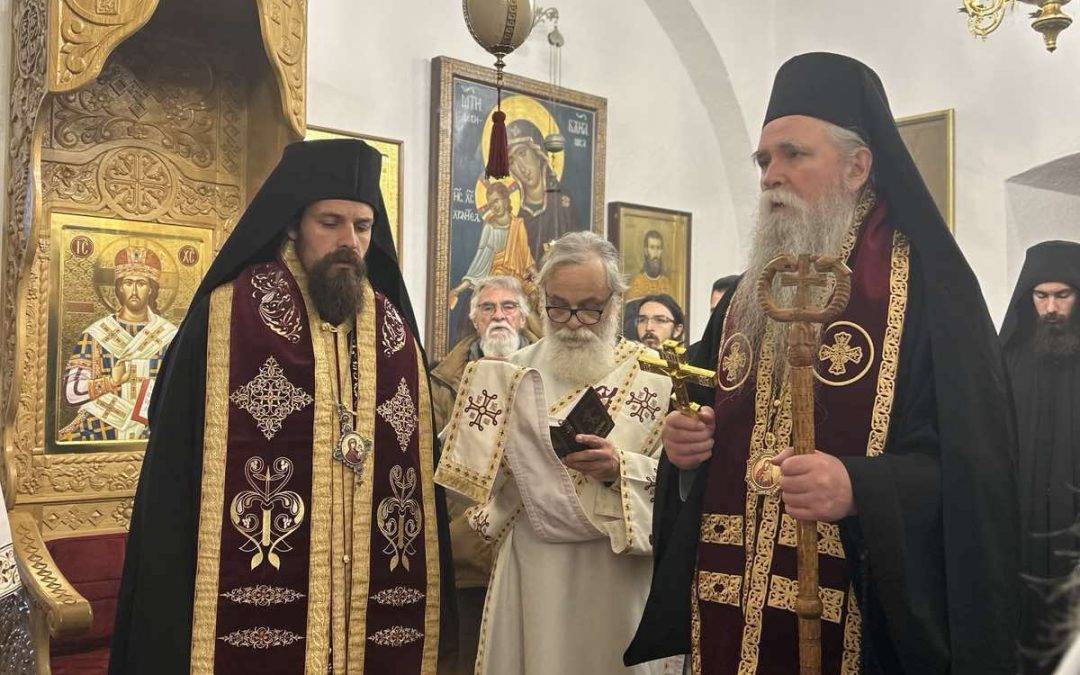
His Eminence Archbishop of Cetinje and Metropolitan of Montenegro and the Littoral, Mr. Joanikije, today, December 10, with the concelebration of His Grace Bishop Paisius of Diocletia, the clergy, clergy and professors of the Theological Seminary of St. Peter of Cetinje, served the annual memorial service for Metropolitan Arsenij (Bradvarević) in the Cetinje Monastery, who reposed in the Lord on this day in 1963 in the Monastery of the Presentation of the Most Holy Theotokos in Belgrade, where he was buried.
After the memorial service, Archpriest Blagoje Rajković, rector of the Seminary of Saint Peter of Cetinje, spoke to the congregation about the personality and life of the late Metropolitan Arsenij (Bradvarević) of Montenegro and the Littoral. We are quoting his address in full:
“Your Eminence, Your Eminence, venerable fathers, dear brothers and sisters.
When a person looks around in this world and tries to serve the name of God in this world, which lies in evil, he can always come to a state of thinking that his time is the most difficult of all times on earth. However, when we look back and look back, when we look into history, which is the teacher of life, when we remember our ancestors, when we remember the first Christians, we see that every time for Christians, in its own way, has been difficult. It has been so since the beginning of Christianity, from those words of Christ, which He said to His apostles, that if they persecuted Him, they will also persecute all Christians, and if they have kept His word, they will also keep theirs.
Thus, dear brothers and sisters, the destiny of a Christian in this world is to bear witness to the name of of Christ and to suffer all that this world imposes on him, adhering to his path that leads to the Kingdom of Heaven.
On this day, when we commemorate the blessed memory of Metropolitan Arsenij (Bradvarević) of Montenegro and the Littoral, when we remember his life, we can say that the time in which we live, which is difficult, is still not the most difficult time in which our ancestors lived and in which the Orthodox Christian lived.
The time in which Metropolitan Arsenij lived was difficult in many ways. He began his life during the Austro-Hungarian Empire at the end of the 19th century. He was born in 1883 in what is now Banat, his ancestors were originally from these regions, and they went there during the migration of Serbs, of which there were many, not only the great migrations under Patriarchs Arsenij III and Arsenij IV. Metropolitan Arsenij was born as Svetislav Bradvarevic in 1883 and during his life he experienced many times, many regimes, and he lived in many countries because it was a turbulent time – the entire 20th century. Two world wars and many other important events, both pleasant and unpleasant, happened in his time. This man of God carried all of this on his shoulders. First, he served God as a priest, he was a married man, he had a family. From his youth, he cultivated a love for God, which he inherited from his parents, as well as a love for his family.
He graduated from the Karlovac Theological Seminary before World War I – at that time it had the status and rank of a faculty, that is, a higher education institution. He served as a priest in several parishes in the Banat Diocese, and then after World War I, wanting to serve the Church even better in the new times, he enrolled in the Faculty of Law and graduated from it in Belgrade. So he had a high theological and legal education.
Throughout his life, both as a parish priest and then as an official of the Church Court, first of the Banat Diocese and then of the Great Church Court, he bore witness to the justice of God. Thus, this man of God, in the time between the two world wars, which was also not easy for the Church, although there was no persecution of the Church, there were many other trials, let us just remember the bloody procession in Belgrade in 1937, he carried all of this on his shoulders. He tried to serve God and his people as best he could.
After he became a widower, when his wife passed away, he accepted the request of the then Patriarch Gavril (Dožić) to become a monk, to be elected as the bishop of Moravia, the vicar of His Holiness the Serbian Patriarch. And in this capacity of the patriarch's vicar, he spent the Second World War, holding on bravely, wisely, preaching and encouraging the people of God in Belgrade during those great trials. And then, when the war ended and it seemed that those trials had passed, new ones came, which were even more difficult for our people, especially the faithful people, in some segments than those war trials.
The new communist regime, at first covertly, and then more and more openly, fought against faith, against the Church, against the name of Christ. At that time, many Christians professed their faith secretly, they baptized children secretly, and rarely married in the church during that period. All this is shown by some data that Metropolitan Arsenij writes about in reports to the Holy Synod of Bishops, which he regularly sent every year from 1947, when he was elected Metropolitan of Montenegro and the Littoral, until 1954 – until his suffering in the communist dungeons. The state of the Church in Montenegro can be seen precisely from those reports in which he mentions that, when he arrived in the Metropolis in 1947, out of the 153 parishes that existed before the war, excluding the north of Montenegro which belonged to the Diocese of Polje-Budimlje, there were 66 active priests. This means that 87 parishes were vacant. Many of these priests suffered during the fratricidal war from 1941 to 1945. Many also suffered immediately after the war, including the blessed memory of Arsenije’s predecessor, the Hieromartyr Joanikije of Lipovac, Metropolitan of Montenegro and the Littoral, and many, many other priests.
When he came to the throne of Saint Peter here in Cetinje, when he was enthroned, Metropolitan Arsenij struggled with various temptations that befell the Church at that time. Of course, a person cannot choose the time in which he will live, in which he will be born, but how he will respond to that time and the temptations that it imposes on him is what makes a person holy or makes him worse than a beast. So this man of God, having come here, immediately began to work to help the clergy, which was in a very poor state, to fight to improve its position. He had many acquaintances in the world, so humanitarian aid and other things came here through him, and he distributed all of it in a Christian way. He gave to priests, but also to the widows of priests whose husbands had suffered during World War II. And this would be one of the complaints of the new communist authorities about the work of Metropolitan Arsenij.
He tried, as best he could, to improve church life. He was a man of meek nature, he was not resentful, he did not compromise much or confront the authorities, unless it was necessary. However, when there were some open attacks on the Church, he courageously stood up in defense of the name of Christ, in defense of the Church of God, and this cost him everything he had achieved there. He was accused by the communist authorities of forming an association with his priests to overthrow the order in Yugoslavia, and on the basis of false accusations and false testimonies in 1954 he was sentenced to prison– to a sentence of rigorous imprisonment by the original verdict of eleven years and six months, and then after an appeal to the Supreme Court his sentence was reduced to five years and six months.
He spent more than two years in the prisons of Montenegro, first in Cetinje and then in Kotor, where, especially here in the Cetinje prison, he was abused by investigators and prison officers, and the director of that prison treated him inhumanely. Metropolitan Arsenij described all of this in his reports that he sent to the Holy Synod of Bishops and in his correspondence with the lawyers who represented him.
He suffered for the Orthodox faith, tortured in the dungeons for more than two years. After that he was allowed to be under house arrest, but he was never again allowed to return to his diocese – the Metropolis of Montenegro and the Littoral, to the throne of Saint Peter. When his prison sentence expired, he asked to be rehabilitated and his diocese returned to him. However, the authorities never allowed him to do so, and he, at the request of the then Patriarch German, in order not to further strain relations with the communist authorities, which were otherwise strained, agreed to be elected Metropolitan of Buda. But he could never go there and take up his see, since the Hungarian authorities did not allow it.
He rested peacefully in the Vavědenja Monastery in Belgrade in 1963 on this day, at the age of 80, which he spent in the service of God and his people.
When we remember this example of his, dear brothers and sisters, we can be grateful to God first of all that we do not live in those times in which Metropolitan Arseny lived, and yet his example also shows us the path that we should also walk in our time. So, not to be someone who will run away, who will deliberately confront the authorities of this world, but when the authorities of this world threaten the Orthodox faith, when they desecrate the name of Christ and when they persecute Christians, we should stand up for them and show that we are truly soldiers of Christ. That we are truly those followers who follow Christ, so that God, together with our wonderful ancestors, may grant us to see His face in the Kingdom of Heaven, in the Kingdom of the Father and the Son and the Holy Spirit, to whom be glory throughout all ages and throughout all eternity. Amen.
May God rest the soul of our blessed Metropolitan Arsenij presented in a holy place, in a place of flowers, in a place of rest, and may he enlighten our path with his example now and always and forever and ever. Amen.”
Vesna Dević
PHOTOS
.png)
RELATED ARTICLES
Calendar for March 21 Saint Theophylact the Confessor
When the first imperial advisor Tarasius, as a layman, was elected Patriarch of...
Announcement from the regular annual assembly of the clergy and monastics of the...
On Thursday, March 19/6, 2026, on the feast of the 42 martyrs of Amorea, the...
IN THE TREASURY OF THE SPC, A LECTURE WAS GIVEN BY ARCHPRIEST-STAVROFOR GOJKO PEROVIĆ:...
As part of the series of lectures during Great Lent, the guest in the Treasury...