Metropolitan Joanikije gave a lecture on the topic: The Secret of the Lovćen Chapel
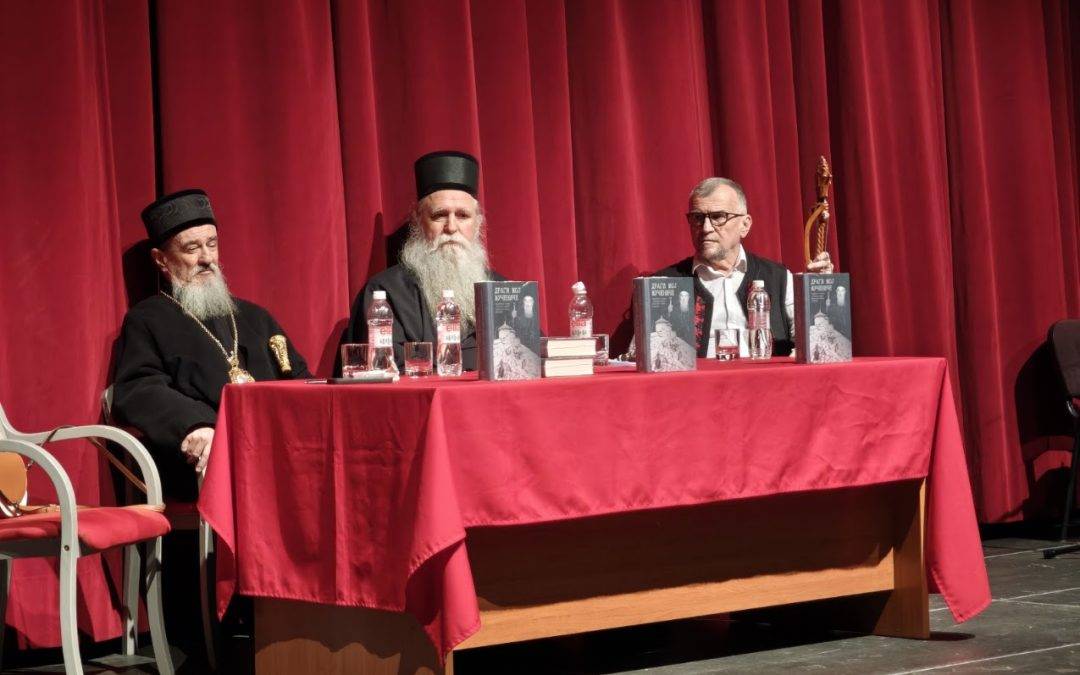
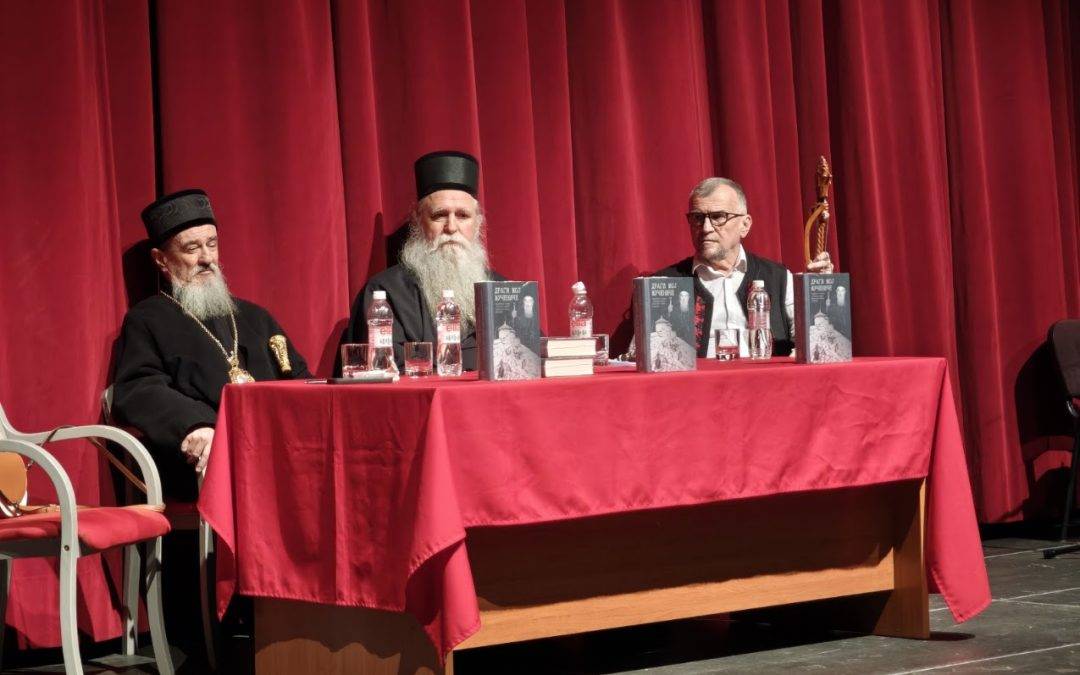
His Eminence Archbishop of Cetinje, Metropolitan of Montenegro and the Littoral, Mr. Joanikije, last night, in the hall of the Pljevlja Cultural Center, gave a lecture on the topic: The Secret of the Lovćen Chapel.
Njegoš's verses were sung to the strings of the gusal by Radosav Rajo Vojinović
His Eminence Metropolitan of Milesevo, Mr. Atanasije, opened and blessed the evening. He welcomed and thanked Metropolitan Joanikije for his visit and lecture.
In his opening speech, he recalled the words of the Apostle Paul when he addressed those to whom he preached, namely that we are all Christ's.
"Our task, we feel, is to prove, show, and reveal our Christian qualities, the Christian characteristics of faith in the Lord, of love as a lifestyle, of harmony. And the Church of Christ strives to show and manifest its qualities in every time. That is why we are now celebrating the jubilee of the Symbol of Faith, which depicts and says this in words that by believing in God the true Father, Son, and Holy Spirit, we also believe in one, holy, catholic, and apostolic Church, and we strive to show and establish the qualities of that unity in every time and this time. This is the space of one, holy, catholic, apostolic Church of Christ. Our Church is apostolic thanks to the fact that it is St. Sava's. The Church shows its qualities by speaking in the temple, and it shows its true nature in the temple where the Divine Liturgy is served and where we gather and show that we are followers of the Holy Sava.
We have the honor of having His Eminence Metropolitan Joanikije speak to us tonight about one of such temples, which is both a lofty geographical point and an existential support," concluded Metropolitan Atanasije and gave the floor to Metropolitan Joanikije.
At the beginning of his speech, Metropolitan Joanikije emphasized that the story of the Lovcen Chapel is complex and multi-layered, encompassing our past, present, and future, just as Njegoš's spirit permeates all time.
"Great people, great personalities do not live only for their time and in their time, but they live for their time and for the future. They carry the past with them and pass it on and especially think about future generations, and to those who have pleased God, He gives such grace to enter the soul and spirit of his people as Saint Sava, as Saint Bishop Nikolaj and as Njegoš. When Njegoš, in the same year that he wrote "The Light of Microcosm", began the construction of the Lovćen Chapel and ordered that he be buried there, and at the hour of his death he confirmed it and obliged his relatives and heirs to fulfill that bequest, that last wish, and if they did so, he would leave the most terrible curse on them. Since then, the story of the chapel has acquired its special covenantal significance, although every church is like a sanctuary - a covenantal sanctuary.
Of course, Njegoš knew well that plans were being made in Vienna even then, and as time passed after him, those plans became clearer and more direct: Lovćen must be placed under the rule of the Austro-Hungarian monarchy, and it may be that this was one of the motives for him to build an Orthodox church and an Orthodox altar on Lovćen and to protect Montenegro with his grave and his church, but not only Montenegro. He always looked at the entire Serbian people and much wider. He was universal in scope and could not be encompassed or limited by any tribe or territory,” His Eminence the Bishop said.
He continued by emphasizing that the Lovcen Chapel, as his work, is connected and, in fact, fused with his poetry.
“In his entire work, Njegoš sings about the temple very often. He sings about the Orthodox altar, the altar facing east. The most holy sacrifice is offered on it. If we believe in him correctly, as Njegoš says in “The Mountain Wreath,” he has that grace and that power to turn the heavens to his mercy. He sings about the sacred foundation of Solomon, but he also sees that in history it often happens that a pagan temple is built on a sacred foundation, as was the case in many nations, including our people. Is Njegoš there, when he sang about the sacred foundation of Solomon where the temple rose, did he also prophesy what would happen to his church - that on its sacred foundation a building would be erected that had nothing to do with Njegoš? I am talking about Njegoš's mausoleum.
However, if we go a little deeper into the meaning of Njegoš's poetry, Njegoš's works, we see that he does not sing about the Orthodox church only from a historical perspective, but also from the perspective of eternity. He, singing about the historical altar that is visible, looks with his spiritual eyes at that invisible throne of God, the heavenly one. He sings about the heavenly temple that encompasses all the worlds, because he understood the entire cosmos as a building, as the temple of God. He understood the entire cosmos as the Church, which is completely in accordance with the deepest thoughts of the holy fathers. In his "Light of the Microcosm" he sings about the angelic service. He also sings about the service of us Christians on earth here - to the Orthodox altar. Especially about the priestly service. He mentions the Liturgy, Holy Communion, the Holy Mysteries, and fasting. He mentions everything that belongs to the church - the altar, the cross, the Gospel, the chalice, the prosphora, the candle - all that is a feature of our holy faith, and when we speak of the priestly service here on earth through the service of Abbot Stefan, he likens it to the angelic service. To the angelic service in heaven. And these services - ours and the angelic service in heaven, represent one and the same service for Njegoš. When he sings about the incarnation of Christ in "The Light of the Microcosm", he essentially ends those last verses with the Liturgy. With the service. Glorifying Christ, he says: The heavens echo with your praise, the earth glorifies its Savior.
At the Holy Liturgy, we sing how both heaven and earth glorify the name of God and how God's grace is poured out through holy services on both heaven and earth. On the angelic world and on us people on earth. And just as on the angelic faces, as Njegoš sings, divine poetry shines (that is his understanding), and the divine mind shines as well, so on those who serve God (such as Abbot Stefan), their virtues shine and amaze us all.
He describes Abbot Stefan, and at one point Bishop Danilo says in a conversation with Abbot Stefan: There is no more beautiful thing in the world than a face full of cheerfulness, especially like yours, with a silver beard to the waist, with silver hair to the waist, and your face smooth and cheerful, that is a blessing from the Most High. He actually painted a spiritual image, an icon of a virtuous, holy elder who spent his entire life serving the Orthodox altar, as he himself says: I have kindled many torches on the altar of the Orthodox Church, so I have come blind among you, to kindle as much as I can your holy fire on the altar of the Church and honesty. So, that is a reward for those who serve the temple of God. You see, there is a wonderful verse, very difficult to interpret (I will try to interpret it). Precisely when he sings about the incarnation of Christ, whom both heaven and earth celebrate, he says that virtue sanctifies the temple. Virtue is a virtue, but above all what comes to our mind is that Njegoš understands virtue in such a way that no matter how sublime it is, it also needs sanctification, so that it can shine with its full brilliance. And, it cannot shine without Christ and without the temple. Only when we offer our gifts to God through the temple, through worship, will God pour out his light on our gifts, on our souls.
Great spirits who have such deep thoughts, you can never fully explain. They have the ability to communicate such things that constantly feed us. In Njegoš, certain verses always retain a certain mystery and thus provoke us to think and be inspired by them. And you see, although some people, interpreting Njegoš, have said that he did not really sing anything about Christ, it will not be. He ends his "Luča" with such a sublime hymn to Christ the Lord, and at the end of his "Mountain Wreath" he celebrates the birth of Christ again. Christmas celebration on Cetnje. Yule logs are laid in the name of the birth of Christ. Christmas is celebrated, and the freedom that we finally gained on Christmas Eve is also celebrated (at least that's what he says in the Mountain Wreath).
So, it is simply impossible to understand Njegoš's work without understanding what Njegoš sings about the temple. By entering the mystery of the temple in Njegoš's poetry, we actually enter the deepest meaning of his poetry. This was also well felt by the interpreters of Njegoš, especially the Holy Bishop Nikolaj, but this theme is not even remotely exhausted. Therefore, I want to summarize it a little, what Njegoš bequeathed, first of all that he built a church, and then that he bequeathed to be buried in it, does not represent only one of his vows that he, as a bishop (which he has the right to do), be buried in a church (especially if he is the founder) as he is the founder of that church, no mausoleum, no pagan building or pharaonic tomb, but as is provided for by the canons that a bishop, if possible, be buried in an Orthodox church.
So, not only that, but it is also his poetic testament, because in this way he indicated that we approach his work through our holy faith, and he constantly teaches us through the “Light Microcosm”, but since “Light” is simply heavenly poetry, it is not accessible to all of us. But, in “Mountain Wreath” he adapted all of this to the understanding of an ordinary person and he somehow brought all of this from his “Light”, that heavenly truth about the divine, heavenly experience, into “Mountain Wreath” through the events he talks about there, through the personalities, through the customs he mentions. He brought all of this as a gentle, unobtrusive Christian teaching to all those who read “Mountain Wreath” and therefore it is no coincidence that “Mountain Wreath” was called the people’s bible – taught Metropolitan Joanikije.
His Eminence the Metropolitan then referred to the history of the construction and renovation of the Lovcen Chapel and recalled that Prince Danilo fulfilled Njegoš's vow, that later King Nikola made sure that, as much as possible, the Liturgy was served regularly in the chapel, and how the Austro-Hungarians demolished it. He then emphasized the importance of Metropolitan Gavril Dožić in the renovation of the chapel, who prevented the realization of King Alexander's idea to build a mausoleum or some similar building and on whose shoulders the burden of renovation fell, after the king accepted the request of the Serbian Orthodox Church.
Then, His Eminence Archbishop of Cetinje, Metropolitan Joanikije, spoke about the repeated demolition of the chapel, the struggle of Metropolitan Danilo Dajković to preserve it, and stated that at that time there was an "illegal marriage between Nazism and communism" because "the main arguments for the demolition of the chapel came from Savić Štedimlija, and were later elaborated on behalf of Tito by Vladimir Dedijer" and concluded: "The chapel will return to Lovćen when we are better, more united, and when we repent for the sins of at least the last hundred years. Only then will we be able to restore the chapel on Lovćen.
Prepared by: Lana Ostojić
PHOTOS
.png)
RELATED ARTICLES
Calendar for March 21 Saint Theophylact the Confessor
When the first imperial advisor Tarasius, as a layman, was elected Patriarch of...
Announcement from the regular annual assembly of the clergy and monastics of the...
On Thursday, March 19/6, 2026, on the feast of the 42 martyrs of Amorea, the...
IN THE TREASURY OF THE SPC, A LECTURE WAS GIVEN BY ARCHPRIEST-STAVROFOR GOJKO PEROVIĆ:...
As part of the series of lectures during Great Lent, the guest in the Treasury...