Petar D. Šerović: History and Tradition about Saint Sava in the Bay of Kotor
The most important coastal city in the Nemanjić state was Kotor in today's Boka. This city was conquered by the great prefect Stefan Nemanja after a long siege around 1185, and he fortified it and built a palace in it. From that time until 1370, Kotor, and with it almost the entire territory of today's Boka, remained in the Nemanjić state.
This time, according to what we know from history and Saint Sava from various surviving monuments from that time, was a golden age for the entire Boka. This is also confirmed by the abundant folk tradition, which mentions almost all the Nemanjić rulers, and especially Nemanja's youngest son, Saint Sava. As is known, when in 1219 the Serbian church became independent, St. Sava founded, among other new bishoprics in the Serbian state, the bishopric of Zeta. The bishoprics were, according to the custom of the time, at the monasteries. Thus, the see of the bishop of Zeta was located "in Diocletian's Pomerania in the temple of the archistrategist Michael". According to the opinion of our most recognized historians, it has been completely established that the episcopal see of Zeta was in the monastery of St. Arch. Michael on Prevlaka in today's Boka Kotorska.
This magnificent monastery with a church with three apses was fenced in the time of Stephen the First-Crowned on Prevlaka on the foundations of an old, ruined, monastery of the same name. This new monastery and the bishops who lived there are very often mentioned in documents from the 13th, 14th and 15th centuries, and there is especially a lot of information about it in the old, valuable archive of the District Court in Kotor. When Mr. In 1346 the Serbian Archbishopric was proclaimed a Patriarchate, the Zeta Bishopric became a Metropolis, and between 1362 and 1382 the "Metropolitan of St. Michael" on Prevlaka is mentioned more often in Dubrovnik books. During the wars of Balša III Stratimirović with the Venetians in 1405, when Venetian ships threatened the Bay of Kotor, the Metropolitan could no longer remain on Prevlaka, and it is very likely that at that time the seat of the Zeta Metropolis was transferred to the Monastery of St. Bogorodice in Šestanska Krajina. The magnificent Prevlaka Monastery was destroyed a few years later. When the Zeta lord Ivan Crnojević returned to his homeland from Italy in 1481, he built the Monastery of the Birth of the Holy Mother of God in Cetinje, and in this monastery Mr. In 1485, he moved the seat of the famous Zeta Metropolitanate from Krajina, where it is still located today. The ruins of the Prevlaka monastery were described in detail by the late M. Crnogorčević in the "Starinar" in 1893, and they were recently visited and photographed by the famous Belgrade architect Mr. Đurđe Bošković. He discovered the foundations of a small church of an earlier monastery within the walls of the Nemanjić Monastery. Mr. Dimitrije Vitković in the "Glasnik of the Historical Society in Novi Sad" book VII in the discussion: "What was Vretania once", according to which the bishops of Marcana bore the name "Vretania", comes to the conclusion that Vretania was our southwestern Primorje and that our Krajina people stuck to the name Vretania, so as not to be separated from their antiquity.
According to Vitkovic, this ancient site is the monastery of St. Archangel on Prevlaka, that is, in Vrjetanija or Primorje, where the seat of the bishop of Zeta was. Accordingly, the Marča monastery would be dedicated to the St. Archangels, to remind the people of the former famous St. Sava monastery on Prevlaka, where the bishops and metropolitans of Zeta lived for a long time. In the famous Savina monastery near Hercegnovo, a famous cross with an inscription is kept with great piety, in which it is said that it is the cross of St. Sava. Many domestic and foreign scholars have written about this cross. Not far from the Banja monastery, above the town of Perast, on a large rock, from where water springs, you can see what looks like a hand pressed into the stone.
The people believe that this is the handprint of St. Sava, who supposedly brought out the living water that springs there - Something similar is told in Orahovac. On the road between Grahovo and Krivoshie, a human footprint is seen in the stone, and the people believe that the footprint of St. Sava, who often passed through there, was left there. The origin of the name of the field Dvrsno in Krivoshie is also attributed to St. Sava. It is said that when St. Sava was passing through there, a local man inflicted a great insult and injustice, and therefore he cursed that place, which was "mrsno", i.e. flat and fertile, so that in the future it would be called "Dvrsno", and would become rocky. When the saint uttered these words, the whole place was covered with a large layer of stone and thus became rocky and barren.
In the Municipality of Grbalj, there is a tradition that St. Sava on his journey to the Holy Land came to Grbalj and set out to sea from today's Bigovo by boat. History also tells us that St. Sava set out on a boat from Budva to visit the holy places. But there is also a living tradition about St. Sava in Budva. It is said in Budva that St. Sava was once sailing in a boat near the city. The sea was very rough, so the boat could not move forward. The saint threw a small stone over the waves, which reached the islet of St. Nicholas, and wherever the stone flew, a stone path appeared from the sea, a spear higher than the sea surface and straight as if someone had built it with a rope (tunja). St. Sava took that path, and when he reached the island, so that no one would follow him, he stretched out his staff on the surface of the water, and the path sank three feet under the water, and for this reason that shallow water is still called "Tunja". In the village of Luštica, the people tell the story that St. Sava blessed their ancient church of St. Nicholas, as well as the ancient church of St. Sergius and Bacchus on Podima. In the area of the Bishopric of Boka Kotorska, there are seven churches dedicated to St. Sava, which is probably the largest number of churches in our country dedicated to this national saint in such a large area. The oldest of them is the church of St. Sava in Savina, after which the Savina monastery was named, and which, according to popular tradition, was blessed by St. Sava himself. From the above, it can be seen that the memory of St. Sava in our magical Boka is as alive as in any other part of our country, which is proud of its folk St. Sava tradition.
Source: Zetski glasnik, a newspaper for politics, education and economy, Year XI, No. 780, Cetinje, May 27, 1939, p. 2.
PHOTOS
.png)
RELATED ARTICLES
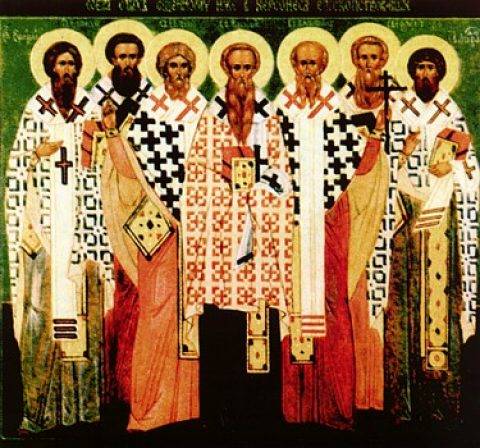
Calendar for March 20 Holy 7 priest-martyrs of Kherson
Basil, Ephrem, Eugenius, Elpidius, Agathodorus, Eterius and Kapiton. All of...
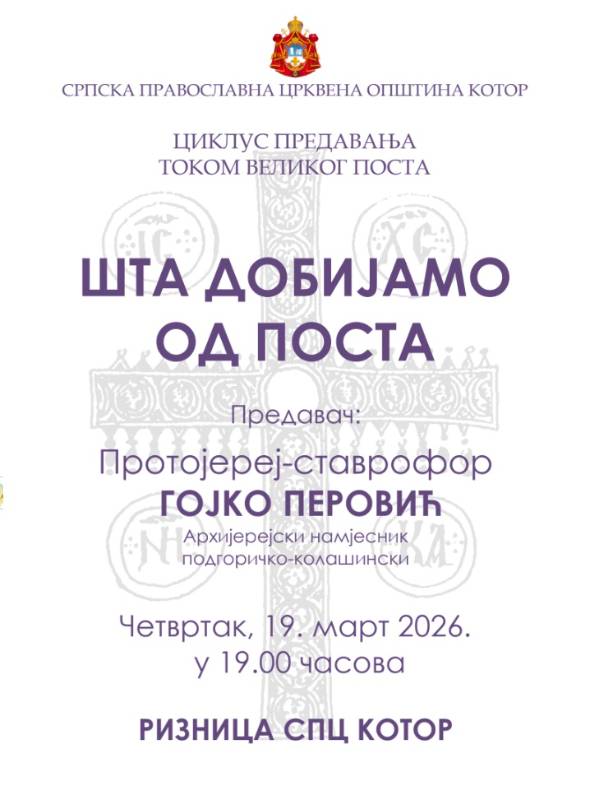
TREASURY, THURSDAY AT 7 PM – GUEST F. GOJKO PEROVIĆ
As part of the lecture series during Great Lent, the guest in the Treasury of...
Calendar for March 19 The 42 Holy Martyrs of Amorea
They were all dukes of the Byzantine emperor Theophilus, who were captured by...