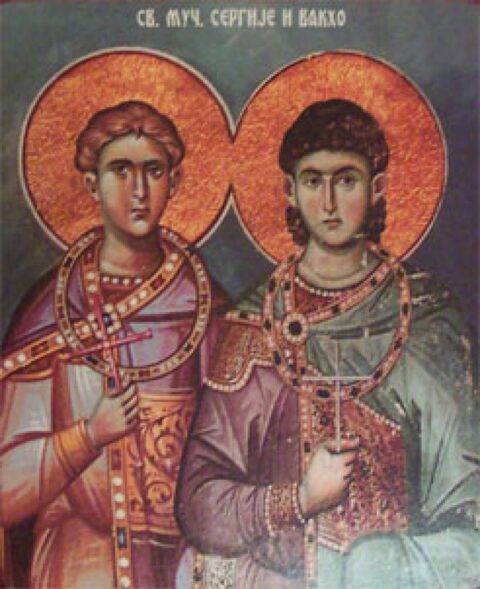
The Holy Martyrs Sergius and Bacchus – Srđevdan
The Holy Martyrs Sergius and Bacchus, Romans by birth, were high-ranking dignitaries and foremost among the nobles at the court of Emperor Maximian. The Emperor held them in great esteem and affection, valuing their wise counsel, their courage in war, and their loyalty in service. Indeed, hardly anyone could approach the Emperor with a request except through these two most trusted advisors; they enjoyed a level of imperial favor unmatched by anyone else. Yet, they sought grace not so much from an earthly emperor as from the Heavenly King; for they believed in our Lord Jesus Christ, strove zealously to please Him through their holy lives, and served Him with great devotion. For a time, however, out of fear of the Emperor, they kept their faith in Christ hidden—for Maximian regarded Christians with boundless hatred and unbridled fury. Nevertheless, the light of the Christian faith could not remain concealed for long; it soon became manifest to all. For certain individuals, envious of their high standing and the Emperor’s affection for them—and seeking to incite his hatred and wrath against them—informed the Emperor that Sergius and Bacchus were Christians and refused to bow down to the gods. Maximian could not bring himself to believe that men who enjoyed such great favor from him were opposed to him in the matter of revering the gods. The Emperor felt ashamed to question or reproach them, as he did not yet know this for certain. Nevertheless, he decided to put the matter to the test in the following way.
One day, he organized a festival in honor of his gods and set out—accompanied by all his princes and nobles, soldiers and servants, and his entire imperial retinue—to the temple of the chief god, Zeus, to offer special sacrifices there. As he did so, he watched closely to see whether his beloved noblemen, Sergius and Bacchus, would enter the temple with him. But when the Emperor entered the temple, the servants of Christ remained behind; they did not accompany him into that loathsome shrine of idols. Instead, they stopped at some distance and prayed to the true God, asking Him to enlighten the blindness of the darkened eyes of that pagan people and to glorify His own most holy name among them. Upon noticing that Sergius and Bacchus had not joined him for the celebration, the Emperor sent his attendants to seize them and bring them by force into the temple of Zeus. When the holy men were brought into that assembly—an assembly hateful to God—Emperor Maximian commanded them to join him in bowing down to the idols, offering sacrifice, and partaking of the food sacrificed to the idols. But Sergius and Bacchus refused to carry out the emperor’s command, saying: "We have a God in heaven—a God who does not deceive, and who is not insensate like your idols, but rather a true and living God who holds the entire world under His dominion; it is He whom we worship." And they began to rebuke the emperor for his impiety, pointing out that he was bestowing the honor due only to God upon blind, deaf, and mute idols—and, furthermore, that he was leading others to do the same.
The Emperor grew angry and ordered that all insignia of their high rank be stripped from them—their military belts, golden armbands, rings, and all their garments—and that, to their shame, they be dressed in women’s tunics, with iron collars placed around their necks. In this state, they were paraded through the city as an object of laughter and mockery, so that these illustrious, noble, and renowned Roman dignitaries might be ridiculed and humiliated by the entire populace—all because they honored the One True God and reviled the false pagan gods—or rather, the demons themselves—to whom these servants of God refused to offer sacrifice, choosing instead to offer themselves as a sacrifice to Christ.
Once the abominable sacrifices had been completed, Emperor Maximian returned to his palace. Feeling a sense of pity for Sergius and Bacchus—for he held them in great affection—he summoned them before him and said: "My dear and faithful friends, why have you chosen to provoke the great gods to anger, to grieve me—your Emperor, who has shown you such favor and kindness—and to bring such disgrace upon yourselves? For although I love you dearly, I cannot tolerate the mockery of my gods; against my own will, I shall be forced to hand you over to shame and torment. I implore you, therefore, my friends: abandon this 'Son of a carpenter'—whom the Jews, treating Him as a common criminal, crucified alongside other criminals—" Do not be led astray by Christian fables and sorcery; instead, turn to our great gods. I shall shower you with great honors and show you the utmost favor; you shall enjoy my love and, together with me, partake in all the riches of my empire.
However, Sergius and Bacchus—unwilling to forsake the love of God for the sake of the Emperor’s favor, or to forfeit eternal blessings for the sake of temporal ones—spoke firmly in opposition to the Emperor. Filled with the grace of the Holy Spirit, they fearlessly and convincingly exposed the impotence of the false gods, boldly confessed the power and Divinity of Jesus Christ, and urged the Emperor himself to come to the knowledge of this truth. But the impious Emperor—whose heart was hardened and obstinate, whose ears of reason were deaf, and whose eyes of the soul were blind—rejected their sound counsel and wise words, becoming instead inflamed with even greater wrath and fury. Yet, because of his deep affection for them, and unwilling to inflict torture upon them himself, he sent them to the East, to the governor Antiochus—a notorious persecutor and cruel tormentor of Christians. This Antiochus had been appointed governor by the Emperor—at the intercession of Sergius and Bacchus—before being dispatched to the East. It was to this Antiochus, then, that these two holy confessors were sent. The Emperor did this so that they might be struck with fear by the cruelty of Antiochus—a cruelty spoken of throughout the entire empire—and, at the same time, feel the shame of having fallen into the hands of one who was once their own servant; he hoped that, through this fear and shame, they would renounce Christ. And if they would not renounce Christ, then at least they would not be tortured and executed before the Emperor’s own eyes, but rather in distant provinces.
And so, the holy confessors were led out of Rome in chains. After spending the entire day on the road, the soldiers escorting them stopped at an inn toward evening to spend the night. There, at midnight—while the soldiers were fast asleep—Sergius and Bacchus began to pray, beseeching God with all their hearts for the strength to endure, with heroic courage, all the torments that lay ahead for the sake of His holy Name. As they prayed, an Angel of the Lord appeared to them, illuminating them with heavenly light and strengthening them with these words: "Servants of Christ, take courage! Fight against the devil like good soldiers, and you shall soon defeat him. For this struggle, you shall receive crowns of victory from Christ the Lord; He will not forsake you in your sufferings, but will grant you His aid until you have trampled the enemy beneath your feet." Having strengthened them with these words, the Angel vanished from sight. Filled with ineffable joy, Sergius and Bacchus began to offer praise to God, who had deigned to visit His servants through the appearance of an angel.
During their long journey to the distant East, the holy martyrs spent their time in fasting, prayer, and the chanting of psalms, thereby arming themselves with spiritual weapons against the invisible spirits of evil. After passing through many cities and lands, they finally arrived in the Eastern provinces, in a city called Barbalissos, where the governor Antiochus was residing at that time. The soldiers delivered the prisoners, Sergius and Bacchus, to the governor, along with an imperial edict containing the following:
“Maximian, the eternal emperor, to Antiochus, governor of the Eastern provinces. Greetings! Our gods do not permit any man—least of all those who are champions and servants of our empire—to be impious or to refrain from offering sacrifices. For this reason, we have condemned Sergius and Bacchus, followers of the impious Christian faith, deeming them deserving of the death penalty. Yet, as they are unworthy of being interrogated by the emperor himself, we entrust them to your discretion. Should they repent, heed our command, and offer sacrifice to the gods, show them your clemency and spare them the torments otherwise ordained for them; furthermore, assure them of our favor, for both shall be restored to their former ranks and showered with our benevolence even more generously than before. If, however, they remain obstinate and persist in their impious faith, subject them to the torments they deserve, and then put them to the sword. Wishing you a long life—farewell.”
Upon reading this letter from the Emperor, Antiochus ordered that Sergius and Bacchus be kept under guard until the following day. The next day, entering the praetorium, Antiochus took his seat as judge; placing the holy martyrs before him, he spoke to them thus: "My fathers and benefactors, it is you who secured this rank for me, and it is through your merit that I enjoy this glory—yet, how your circumstances have changed! Now I sit as judge, while you stand before me as shackled prisoners—you, before whom I once stood as a servant. I implore you, therefore, do not bring such harm upon yourselves; obey the Emperor and offer sacrifice to the gods, and you shall regain your former status and be surrounded by glory once more. But if you refuse, I shall be compelled—against my own will—to hand you over to torture, in accordance with the Emperor’s command; for you yourselves have heard what the Emperor has ordered in his letter. So, my masters, have mercy upon yourselves and upon me, for I have no desire to become the cruel tormentor of my own benefactors."
The saints replied: "Your attempt to beguile us with your words is in vain; for honor and dishonor, life and death—all are one to those who seek the heavenly life. For us, Christ is life, and death for His sake is gain." Saints Sergius and Bacchus spoke much more, glorifying Christ, reviling the idols, and exposing the godlessness of the polytheists. Enraged by this, Antiochus ordered that Saint Sergius be cast into prison, while Bacchus was to be stripped naked, stretched out upon the ground, and beaten without mercy. Saint Bacchus was beaten across his entire body for so long that the servants—exhausted from the task—had to take turns. From such a beating, all the flesh fell from the holy martyr’s bones, his entrails were laid bare, and his blood poured out like water. Amidst these torments, Saint Bacchus surrendered his holy soul into the hands of the Lord. The tormentor Antiochus ordered that the martyr’s body be dragged far outside the city and cast to the wild beasts and birds to be devoured. Yet, the Lord preserved his bones; for some Christians—who, fearing the idolaters, had been hiding outside the city in caves and ravines—emerged from their shelters by night, took the body of Saint Bacchus, and gave it an honorable burial within one of the very caves where they themselves had been hiding. Saint Sergius, while sitting in prison, heard that his friend had passed away; he was deeply saddened and, weeping over their separation, said: "Woe is me, my brother Bacchus! Now it is no longer possible for us to sing together: 'Behold, how good and how pleasant it is for brethren to dwell together in unity!' (Ps. 132:1). You have left me all alone." As Saint Sergius grieved in this manner, Saint Bacchus appeared to him the following night, bathed in heavenly light, with an angelic countenance and radiant military attire. He comforted him by revealing that a reward had been prepared for them in heaven, and he strengthened him for the martyrdom that lay ahead—a feat for which he would receive great grace and boldness before Christ the Lord. This apparition of Saint Bacchus filled Saint Sergius with immense joy, and with a gladdened heart, he sang praises to God.
Shortly thereafter, the governor decided to travel to another city, called Sura, and ordered that Sergius be taken along with him. Upon arriving in the city of Sura, the governor took his seat on the judgment throne and spoke thus to Saint Sergius: "That godless man, Bacchus, refused to offer sacrifice to the gods; he chose to die a violent death rather than pay homage to them—and thus, he received the punishment he deserved for his deeds." And you, my dear Sergius, why do you plunge yourself into great misfortune by clinging to this godless deception? My benefactor, do not deliver yourself up to torture! I am ashamed of the kindnesses you have shown me, and I am ashamed for the sake of your own integrity; for you stand before me like a condemned man, while I sit in judgment over you. I—once a man of no account—was granted a high rank through your intercession with the Emperor, and now I stand above you; yet you, who secured so many favors from the Emperor for so many others, now bring evil upon yourself. For these reasons, I implore you: heed my advice, submit to the Emperor’s command, and offer sacrifice to the gods; then you shall be restored to your former rank and honored with your former glory.
Saint Sergius replied: "Temporal honor and glory are nothing; indeed, through temporary dishonor, one gains eternal glory. Therefore, I care nothing for this earthly disgrace, nor do I desire temporal honor, for I hope to be granted true and eternal honor by my Christ in heavenly glory. You speak of the favors I showed you—by securing this high office for you from the earthly Emperor—" And now I say to you: listen to me, and, having come to know the truth, renounce your false gods; then, together with me, worship the Heavenly God and King of the Ages—and I promise you that I shall secure for you, through Him, even greater blessings than those you could obtain from Maximian.
Then Antiochus, seeing that he could neither turn him away from Christ nor persuade him to submit to the emperor’s will, said: "Sergius, you compel me to forget all the kindnesses you have shown me and to hand you over to cruel torments." Sergius replied: "Do as you please; I am aided by Christ, who said: 'Do not fear those who kill the body but cannot kill the soul' (Matthew 10:28). You may have power over my body—you can subject it to torture—but neither you nor your father, Satan, has any power over my soul."
Enraged, Antiochus said: "I see that my forbearance has made you insolent." He then ordered that iron sandals, studded with long, sharp nails, be placed upon his feet; the nails pierced the saint’s soles. The tormentor commanded that the martyr, shod in this manner, be driven ahead of his chariot—for he was setting out for the city of Tetrapirgia, from where he intended to travel on to the city of Resafa. The holy martyr ran before the chariot, singing: "I waited patiently for the Lord; He inclined toward me and heard my cry. He lifted me out of the pit of passions, out of the miry clay; He set my feet upon a rock and made my steps secure" (Psalm 40:1–2). Upon arriving at the city of Tetrapirgia—situated twenty kilometers from Sura—they led the martyr away to prison. On the way to the dungeon, the martyr sang: "Those who once ate my bread have lifted their heel against me, and with the bonds of cruel torments have set a snare for my feet; but You, O Lord, hasten to my aid, restrain them, and deliver my soul from the ungodly" (cf. Ps. 40:10). That night, as the martyr prayed in the dungeon, an Angel of the Lord came to him and healed his feet.
The next day, Antiochus ordered that Saint Sergius be brought out of the dungeon, assuming that, due to the pain, he would not even be able to take a step. However, when he saw the martyr from afar—walking like a perfectly healthy man, without the slightest limp—the tormentor was struck with horror and exclaimed: "Truly, this man is a sorcerer! How is it possible, after such torments, to walk without a limp? Look at him—it is as if his feet had never suffered at all! There is some magical power at work here."
Following this, Antiochus ordered that the same sandals be placed back on the martyr’s feet, and that he be led in this manner all the way to Resafa—a distance of seventy stadia from Sura. There, taking his seat on the tribunal, Antiochus began to coerce Saint Sergius into bowing down before the idols. But, as he could not turn him away from the faith in Christ, he sentenced him to death. When the martyr was led outside the city to the place of execution, he requested time to pray. And as he prayed, he heard a voice from heaven calling him to the dwellings on high; and, joyfully bowing his head beneath the sword, he departed this life. The Christians buried his body in that very same place.
Some time later, the Christians of the city of Sura resolved to secretly take the body of the holy martyr Sergius from Resafa and transport it to their own city. But when they approached the holy martyr’s tomb during the night, a fire shot forth from it like a pillar reaching up to the heavens. Certain soldiers stationed in Resafa, seeing a tall pillar of fire at midnight that illuminated the entire city, rushed to the spot fully armed; there, they found the citizens of Sura, who were terrified by the appearance of the fiery pillar. The pillar of fire gradually vanished, and the citizens of Sura revealed their intention, realizing that the holy martyr did not wish to leave the place where he had shed his blood and laid down his soul for Christ. After remaining there for several days, they erected a magnificent, tall stone tomb on that site. Later, as the holy faith in our Lord Jesus Christ spread, a church dedicated to the holy martyr Sergius was built in the city of Resafa. Fifteen bishops from the surrounding cities gathered and solemnly transferred the incorrupt and fragrant relics of the holy martyr into the newly built church, decreeing that his commemoration be celebrated on the seventh of October—the very day upon which he suffered. In both places—both in the church near the holy relics of the martyr Sergius, and at the site where he passed away and was first laid to rest—many who were sick or possessed by demons received healing.
It is also worth noting that every year, on the feast day of the holy martyr, wild beasts—as if fulfilling some law—would emerge from the surrounding wilderness and gather at the place where the holy martyr was first buried. During this time, they would set aside their savage nature and adopt the gentleness of lambs; they would not attack any human or livestock, but instead would meekly circle the holy site before returning to the wilderness. In this way, God glorified His servant, inspiring even the wild beasts—just as He did with people—to honor the holy memory of the martyr. Through his prayers, may the all-merciful God tame the fury of our enemies, just as He once tamed the fury of wild beasts, to His own glory forevermore. Amen.
PHOTOS

RELATED ARTICLES
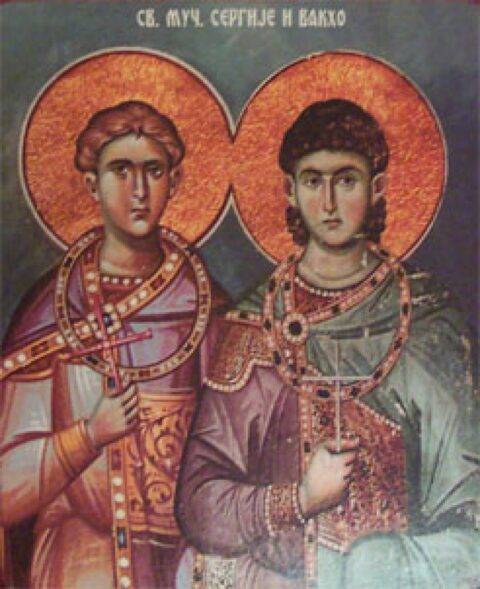
The Holy Martyrs Sergius and Bacchus – Srđevdan
The Holy Martyrs Sergius and Bacchus, Romans by birth, were high-ranking...
Patron Saint Day of the Risan HospitalHis Grace, Bishop Pajsije of Diokleia,...
Calendar for October 19 Holy Apostle Thomas – Thomindan
One of the Twelve. He doubted that the Lord had risen. "Reach your finger here,...