
Christmas Epistle of the Serbian Orthodox Church
SERBIAN ORTHODOX CHURCH
TO ITS SPIRITUAL CHILDREN ON CHRISTMAS 2025
PORPHYRIJE
The Orthodox Archbishop of Peć, Metropolitan of Belgrade and Karlovac and Patriarch of Serbia, with all the hierarchs of the Serbian Orthodox Church – to the clergy, monasticism and all the sons and daughters of our holy Church: grace, mercy and peace from God the Father, and our Lord Jesus Christ, and the Holy Spirit, with all-joyful Christmas greetings:
Peace of God – Christ is born!
Dear brothers and sisters,
And in this year of the Lord’s grace, sharing with all of you the joy of Christmas, let us once again proclaim the only new thing under the sun: the encounter, embrace and kiss of the transitory and the imperishable, of heaven and earth, of God and man—the birth of the Savior who is Christ the Lord (Luke 2:10-11). Let us proclaim with the shepherds, bow with the wise men and sing with the angels: “Glory to God in the highest, and on earth peace, good will toward men!” (Luke 2:14). This angelic song tells us that peace is a gift from God, and invites us to accept it and participate in that gift.
Such peace is not the consequence of human agreements or the result of a balance of power, but the state of a transformed person who believes, lives and walks the path of Christ and who, having peace with God and with himself, spreads peace among his brothers and sisters. Since Christ the God-Child bestowed upon her the “ministry of reconciliation” (II Cor. 5:18) by his birth, the Church of God has been constantly healing the wounds of division, renewing broken ties, re-establishing a unity that knows no human boundaries, blessing peace and peacemakers. This blessing of the Church obliges us to spread peace ourselves. Therefore, we address all of you, dear spiritual children, and everyone who listens to our words with good intentions. Christmas is a feast of peace, and the angelic Christmas carol is a prayer for peace, unity, and reconciliation, based on faith in God and living according to God.
Today, more than ever, humanity needs to return to that source of peace that is not imposed by force but is revealed in humility, in a love that “does not seek its own” (1 Cor. 13:5) and in a relationship that builds trust, unity and respect for every person. For it is precisely with the birth of Christ that the world gains the measure by which it can understand itself, which is why we feel even more clearly the weight of the times in which we live. We live in a time of ever-deepening religious, ethnic and cultural divisions, in a world in which geopolitical tensions are constantly growing and in which wars are becoming an increasingly frequent means of resolving economic and political conflicts. The change in the global order and the struggle of great powers for dominance are giving rise to instability, security crises and fear of an uncertain future.
Added to this are economic insecurity, inflation, growing inequality, poverty, hunger and the uncontrolled depletion of natural resources. Technological transformations, however, bring new ethical dilemmas and give rise to digital isolation — an apparent presence without real community. All this leads to a crisis of trust in institutions and the media, to the relativization of truth, to an increase in anxiety and loneliness, and even to the loss of meaning in life for many people today. And therefore, many of us welcome this holy night and this holy day with restlessness in our hearts, worrying about our children and their future, about daily bread, about health, about tomorrow.
The situation in Serbia, which our entire people are watching, is no less complex and difficult. Internal political tensions have led to a deep division in society and distrust among people, and differences in opinions are increasingly developing into irrational hatred. The loss of national and cultural identity is particularly worrying, which calls into question the continuity of the historical and spiritual self-concept of our people, and cannot be explained solely by external influences. In addition, there is economic uncertainty and demographic decline: Serbia is facing a significantly negative natural increase and, consequently, one of the fastest depopulations in the world, as well as an increasingly pronounced aging of the population.
Bearing all this in mind, looking with open eyes at the dark clouds looming over us, not closing our eyes in the face of the problems and dangers listed and not running away from them, we today, as living witnesses of the angelic word to the shepherds, announce to all of you, our spiritual children, again: “Do not be afraid!” (Luke 2:10). Why? Do not be afraid, for the world in which we live, with all its fractures, conflicts, and fears, is no longer self-sufficient and self-explanatory, nor is it at the mercy of the blind forces of history. With the birth of Christ, God entered the very heart of human history and showed that evil, no matter how aggressive and widespread, does not have the last word. Fear is born where man thinks he is alone—and the birth of our Savior Christ reveals to us that we are no longer alone and that we will never be alone again.
Therefore, neither the crises of our time, nor wars, nor the loss of trust, can be the final measure of human life nor the last word about man. Fear still exists, but it no longer shackles life. It is deprived of its ultimate power over man. This transformation has its source and foundation in Christ himself, who reconciled man with God and thus laid the foundation of peace that fear cannot abolish (II Cor. 5:18). Having destroyed the barrier of hostility, He destroys the divisions that separate people and nations (Eph. 2:14). This reconciliation is shown in the liturgical and sacramental life of the Church as a reality in which ethnic and social, and even natural, differences between people (Gal. 3:28) no longer have decisive significance. From this truth about reconciliation also flows our relationship to the time and the world in which we live. Ninety-five years ago, the Ohrid hermit and poet, Saint Bishop Nicholas, wrote: “When did the Lord appear to the world? He appeared in a time of trouble, when God was not glorified, when there was no peace on earth, and when instead of good will, ill will reigned among people.” It is the same today in many ways.
Our time also bears deep similarities to the time of Christ’s birth. At that time, in our vast expanse, there was one great global power — a dominant empire that shaped the world order of that time. Today, there are more of these powers. They govern the world and direct the destinies of smaller nations, whose governments, like Herod’s at the time of Christ’s birth, have formal independence, but are essentially dependent on the economic, energy, political, and military interests of great powers. Let us remember that the census at the time of Christ’s birth was also a political and economic instrument of control: whoever is registered recognizes the authority and pays taxes. But it is very similar today, when personal data, as much for good purposes as for the sake of it, and increasingly, is used to control and limit the freedom of each individual. The birth of Christ itself, in its manner, place and time, becomes a service of unity: in it, history ceases to be a series of coincidences and becomes a space of salvation. The place and time of Christ’s Birth speak with powerful symbolism: the God-child is not born at an ideal moment; He enters wounded history in order to open up the perspective of its healing and fulfillment from within. He is born in a cave and is laid in a manger — not to highlight human poverty, but to show the state of the world in which there is room for everything and everyone, but not for God. That is why Christ could not have been born in the warmth and security of prosperity. By the very nature of the event, He is born in a cold and desolate place—a place hungry for God. Every human heart is such a cave until Christ is born in it. Christ’s birth in poverty reveals that before Him and in Him the divisions by which the world values people cease. The family is the first place where a person learns what peace means—or what its loss means. The home is transformed into a true manger of the Nativity of Christ when there is room in it for forgiveness, patience, and common prayer. The Lord is born in the silence of the Bethlehem night, far from the noise and self-sufficiency of the world. In that silence, man hears in prayer the voice of God again, which calms the heart and dispels fear. In that silence and prayer, man becomes man again, and the family becomes family. In the cave of Bethlehem, shepherds and wise men meet, not so that one may be exalted and the other humbled, but so that both may become brothers in Christ. He comes to those who have nothing and to those who have too much, because both lack God. Ultimately, Christ dwells neither in a palace nor in a cave, but in every person who receives Him into their heart. And this reconciliation, which God the Father grants to the world through Christ, does not stop at humans alone, but encompasses all of God’s creation—“things on earth and things in heaven” (Col. 1:20).
Therefore, dear brothers and sisters, let us remember: the feast of the Nativity of Christ carries two essential messages, two truths. The first is that God became man for us and for our salvation. The second, which arises from the first, is that every person, precisely for this reason, can and should become our brother. For only in Christ, the Firstborn among many brothers (Rom. 8:29), do we regain the other as a neighbor and brother. Therefore, before the mystery of the birth of Christ, God's question, as old as humanity itself, is asked to each of us anew: "Where is your brother?" (Gen. 4:9). Not where is your interest, nor where is your side, nor where is your party, nor — ultimately — where are you yourself, alienated and focused only on yourself, but — where is the man who was given to you so that, by loving him, you might pass from death to life (I John 3:14). That and that alone is our basic question and our central task, this and every other Christmas. Love is from God (I John 4:7 and 21). Therefore, brothers and sisters, let us love one another, “not in word or tongue, but in deed and truth” (I John 3:18), for he who hates his brother is in darkness, but he who loves his brother abides in the light (I John 2:9 – 11).
Into that light and life in peace and harmony, inspired by the transcendent joy of Christmas and the peace of Christ, we call upon everyone to overcome divisions, to embrace one another, to extend a hand to one another, to understand that, in a word, we are indispensable to one another, because the Christian faith does not teach us to wait for better times in times of crisis, but to become living signs of the future kingdom of God ourselves — people who already live differently now, who do not cure fear with fear or hatred with hatred.
Finally, brothers and sisters, children of Saint Sava and all our venerable ancestors, all the holy Serbian Fathers and Mothers, wherever we are across the land, in our homeland or in exile, and especially in crucified Kosovo and Metohija, with one voice, one mouth and one heart, together with the angels let us sing the Christmas hymn, the song of peace:
Glory to God in the highest and on earth peace, good will among men!
Peace of God – Christ is born!
Given in the Serbian Patriarchate in Belgrade,
on Christmas 2025. of the year of our Lord.
Your prayer books before the Infant Christ:
Archbishop of Pec, Metropolitan of Belgrade-Karlovica and Patriarch of Serbia PORPHYRIJE
Archbishop of Sarajevo and Metropolitan of Dabro-Bosnia CHRISTOM
Archbishop of Cetinje and Metropolitan of Montenegro-Lithuania JOANIKIJE
Archbishop of Sirmium and Metropolitan of Srem VASILIJE
Archbishop and Metropolitan of Banja Luka EPHREM
Archbishop and Metropolitan of Buda LUKIAN
Archbishop of Vrsac and Metropolitan of Banat NIKANOR
Archbishop of Novo Gračanica-Chicago and Metropolitan of Midwestern America LONGIN
Archbishop of Toronto and Metropolitan of Canada MITROFAN
Archbishop of Novi Sad and Metropolitan of Bačka IRINEJ
Archbishop of Stockholm and Metropolitan of Scandinavia DOSITHEJ
Archbishop and Metropolitan of Žička JUSTIN
Archbishop and Metropolitan of Vranje PAHOMIJE
Archbishop of Kragujevac and Metropolitan of Šumadija JOVAN
Archbishop of Požarevac and Metropolitan of Braničevo IGNATIJE
Archbishop and Metropolitan of Zvornik-Tuzla PHOTIJE
Archbishop and Metropolitan of Milesevo ATHANASIJE
Archbishop of Düsseldorf-Berlin and Metropolitan of Germany GRIGORIJE
Archbishop and Metropolitan of Raska-Prizren THEODOSIJE
Archbishop and Metropolitan of Kruševac DAVID
Archbishop of Romuliana-Zaječar and Metropolitan of Timočka HILARION
Archbishop and Metropolitan of Niš ARSENIJE
Archbishop of Sydney-Wellington and Metropolitan of Australia-New Zealand SILUAN
Archbishop of Zadar-Šibenik and Metropolitan of Dalmatia NIKODIM
Archbishop and Metropolitan of Budimlje-Nikšić METHODIJE
Archbishop of Mostar-Trebinj and Metropolitan of Zahumlje-Herzegovina and Ston-Littoral DIMITRIJE
Archbishop of Los Angeles and Western America MAXIM
Archbishop of Gornja Karlovac GERASIJE
Bishop of Washington-New York and Eastern America IRINEJE
Bishop of Pakrac and Slavonia JOVAN
Bishop of Switzerland ANDREJE
Bishop of Bihać-Petrovica SERGIE
Bishop of Buenos Aires and South-Central America KIRILO
Bishop of Osijek-Poland and Baranja CHERUVIM
Bishop of Valjevo HYSIKHIJE
Bishop of Šabac YEROTHEJE
Bishop of Paris and Western Europe JUSTIN
Bishop of London and Great Britain and Ireland NEKTARIJE
Bishop retired of Zvornik-Tuzla VASILIJE
Bishop retired of Canada GEORGIJE
Bishop retired of Central Europe KONSTANTIN
Bishop retired of Slavonia SAVA
Bishop retired of Milesevo FILARET
Bishop retired of Niš JOVAN
Vicar Bishop of Remezia Stefan
Vicar Bishop of Mohacs DAMASKIN
Vicar Bishop of Marčana SAVA
Vicar Bishop of Hum JOVAN
Vicar Bishop of Hvostan ALEXEIJ
Vicar Bishop of Novo Brdo HILARION
Vicar Bishop of Lipljan DOSITHEJ
Vicar Bishop of Toplica PETER
Vicar Bishop of Jenopolje NIKON
Vicar Bishop of Moravica TIKHON
Vicar Bishop of Diocletian PAISIUS
Vicar Bishop of Kostajnica SERAPHIM
PHOTOS
.png)
RELATED ARTICLES
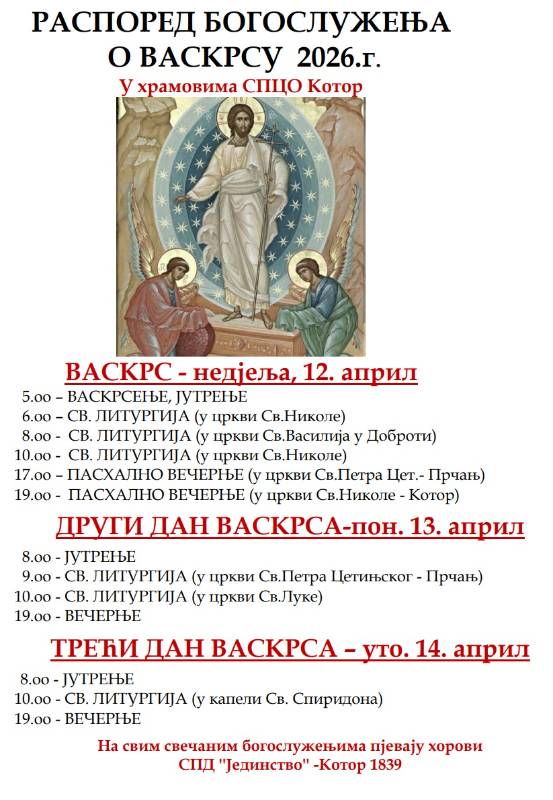
SCHEDULE OF EASTER SERVICES 2026 IN THE CHURCHES OF THE SPCO KOTOR
EASTER - Sunday, April 125:00 - RESURRECTION, MORNING6:00 - HOLY LITURGY (in...
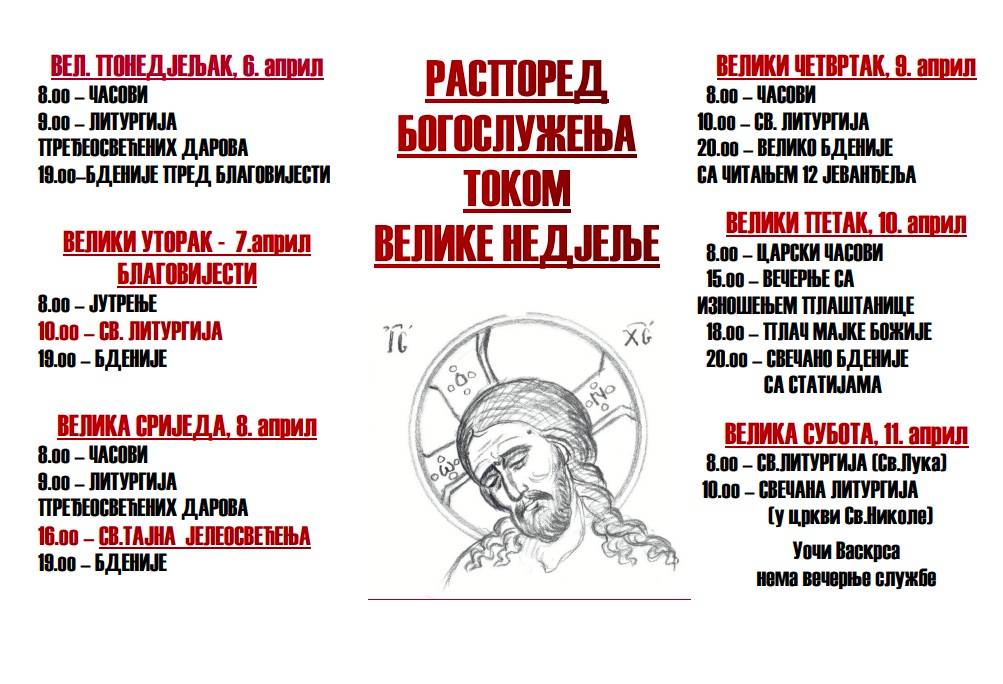
HOLY SUNDAY SERVICE SCHEDULE
HOLY MONDAY - April 68:00 AM - HOLY LITURGY7:00 PM – VIGIL MAY WEDNESDAY...
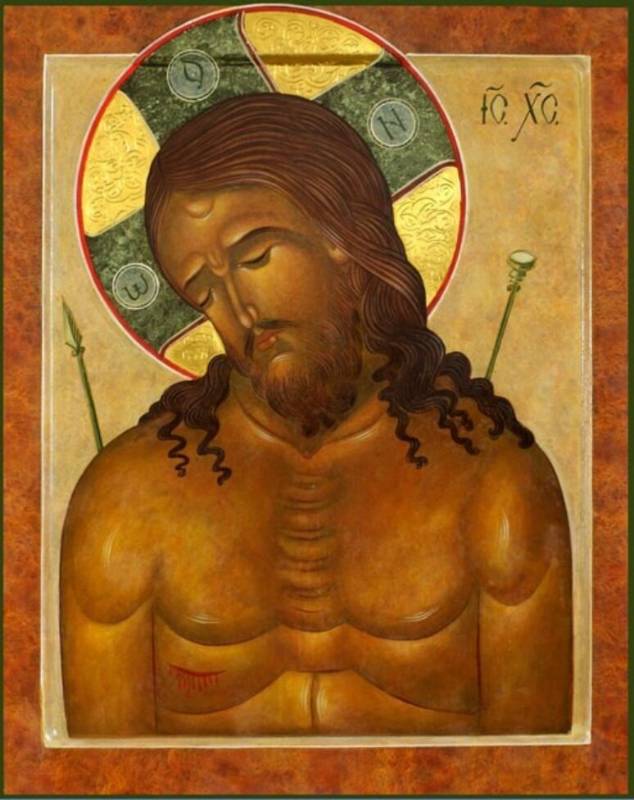
Calendar for April 11 Maundy Saturday
On the Saturday after the crucifixion, the chief priests and Pharisees came to...