Seventeen Years Since the Repose of Serbian Patriarch Pavle
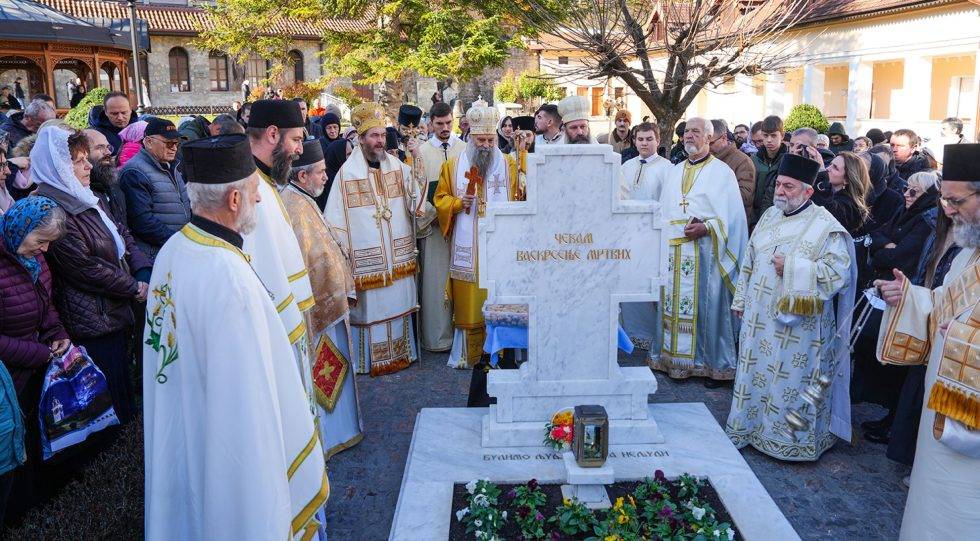
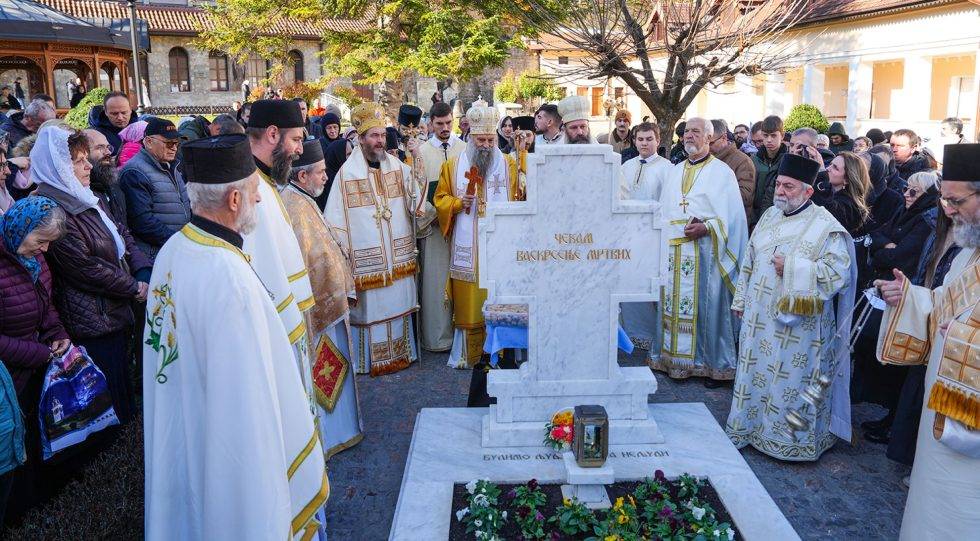
On November 15, 2026, His Holiness the Serbian Patriarch, Porfirije, celebrated the Holy Liturgy at Rakovica Monastery, followed by a memorial service for the late Serbian Patriarch Pavle, of blessed memory, marking seventeen years since his passing.
Reflecting on the Gospel passage—which recounts the healing of the woman with an issue of blood and the raising of Jairus’s daughter—Patriarch Porfirije emphasized:
“In her example, we see the truth to which the Holy Fathers bear witness—the same truth we express in the prayer ‘O Heavenly King,’ when we address the Holy Spirit, saying: ‘Who art everywhere present and fillest all things.’ Thus, the Holy Spirit—the grace of God—is present everywhere, in every place. But where does it act, where does it manifest and reveal itself visibly? It does so wherever faith appears. And indeed, we saw this in the case of the woman with an issue of blood: through the contact of faith with the very garments of our Lord Christ, the Evangelist tells us, ‘she was healed immediately.’ She was restored to health at once. Therefore, wherever there is true and genuine faith, the barriers and obstacles to the working of the Holy Spirit—to the working of the grace of the Holy Spirit—are broken down.” — Let us preserve our Orthodox faith—but let us preserve it through our lives, day by day, by fulfilling God’s commandments. For through the fulfillment of God’s commandments—by means of faith—our souls and hearts are cleansed, opening the prospect of knowing God and encountering Him. It opens the way to a deeper understanding—the very state attained by God’s saints and apostles—where there is no longer any dilemma between good and evil. As the Holy Apostle Paul says: "It is no longer I who live, but Christ lives in me." Through his faith—which is life, humility, and crucifixion—Christ was formed within him; it is Christ who speaks through him, and Christ who thinks within him. He directs the thoughts, words, and deeds of the Apostle Paul, and of all the saints who have become like Christ. This is our high calling. And as we move toward the knowledge of the living God—through faith in Him and love for Him—we begin to know ourselves, to understand life and its meaning, and to truly know our neighbors. Then we come to understand Christ’s words: "Love your neighbor as yourself"—for, prior to this, you have already embraced God as the law and guiding principle of your life. We then realize that we need one another, and we become capable of forgiving one another—for this is the very purpose of our existence. Let us not cast others aside, and let us not harbor hatred—for there is no poison greater than hatred. Hatred poisons the one it permeates, the one who is carried along by it. Therefore, let us be one with God, and one among ourselves—in our diversity, not in a forced uniformity of thought, but in one faith, one love, and one hope. Let us never lose hope; let us live by faith, and let love be the beginning and the end of our lives—love for God and for our neighbor,” emphasized the Serbian Patriarch, Porfirije.
Following the Holy Liturgy, the Patriarch served a memorial service (*parastos*) for the late Patriarch Pavle, and on that occasion, he remarked:
“Brothers and sisters, we have served a memorial service for the late Serbian Patriarch Pavle. We prayed for the repose of his soul, but we also prayed to him—asking him to pray for us—that we might become what he wished for us to be, and what he called us to become. This is encapsulated in a few simple words: ‘Let us be human beings.’ This means, brothers and sisters, that the mere fact that we are human by nature does not necessarily mean that we are truly authentic, genuine human beings. To be a human being is a given—that is the essence of the message of the holy Patriarch Pavle. It is, therefore, both a gift and a task.” We are created in the image and likeness of God as human beings, and we possess certain gifts; however, whether we will ultimately allow God’s grace to multiply these gifts—enabling us to become truly conformed to Christ and to exist as authentic, genuine human beings—depends on us and the choices we make. Thus, when the holy Patriarch Pavle urged us to "be human," it implies that, although we are human by nature, we often fail to be truly human. We cease to be human when we exist outside of Christ—outside of His Church, which is His Body—or when we adopt as the criterion for our lives something or someone other than Christ (often even something opposed to Christ). We fall short of being the human beings we ought to be—the beings the Lord envisioned us to be—whenever our standard and measure lie outside the Church, outside of Christ’s Church, or, as is often the case, in opposition to it. To be human means to exist in Christ, to exist within the God-man. We are truly human—you are, and I am—only when the God-man serves as our framework, and when we have identified ourselves with the God-man, our Lord Jesus Christ. This is the call and the blessing of the late Patriarch Pavle; this is his prayer. Therefore, as we gather here today to pray for the repose of his soul, we pray just as fervently—if not even more so—to him, that he, together with Saint Sava, Saint Prince Lazar, Saint Deacon Avakum, Saint Vukašin of Klepci, Saint Bishop Nikolaj, Saint Abba Justin, and all the saints of our lineage, may help us to truly become human beings—that is, to become a person through whom Christ thinks, speaks, and feels, and in whom Christ—the God-man—lives. Eternal rest; may God forgive his soul!
Concelebrating with the Head of the Serbian Orthodox Church were: Their Graces, the Vicar Bishops Ilarion of Novo Brdo and Dositej of Lipljan; Archpriests-Stavrophore Radič Radičević and Đorđe Trajković; Archpriest Simo Kličković; Priest Goran Nuhanović; Protodeacons Dragan Radić, Radomir Vrućinić, and Stevan Rapajić; and Deacons Vasilije Perić and Mihailo Puača. Also present in prayer were Abbess Evgenija of Rakovica Monastery, her sisterhood, and a large number of the faithful.
Following the memorial service, Serbian Patriarch Porfirije welcomed approximately 150 students from the "Patriarch Pavle" Gymnasium. They had arrived in a procession from their school to the monastery, accompanied by their principal, Mr. Jasmin Nikolovski, several teachers, and religious education instructors—Mr. Slaviša Kostić and Deacon Vuk Erceg.
***
Patriarch Pavle was born Gojko Stojčević on September 11, 1914, in the Slavonian village of Kućanci, near Donji Miholjac. He lost his parents at an early age. From the age of three, young Gojko was raised by his aunt. He completed his lower secondary education in Tuzla and his upper secondary education in Belgrade. After graduating from the Seminary in Sarajevo in 1936, he enrolled in the Faculty of Theology in Belgrade, from which he graduated in 1942. During the Second World War, he served as a religious education teacher at a home for refugee children in Banja Koviljača. In August 1944, Gojko contracted tuberculosis; doctors predicted he had only three months to live. He was healed through prayer at the Vujan Monastery. In gratitude to God for restoring his health, he carved a cross, which is still kept in the monastery today. Following a period as a novice, he was tonsured a monk in 1948 at the Blagoveštenje (Annunciation) Monastery in the Ovčar-Kablar Gorge, receiving the monastic name Pavle (Paul), after the Apostle of Love. From 1949 to 1955, he was a member of the monastic community at the Rača Monastery. He spent the 1950/1951 academic year as a teacher at the Seminary of Saints Cyril and Methodius in Prizren. He was ordained as a hieromonk in 1954. From 1955 to 1957, he pursued postgraduate studies at the Faculty of Theology in Athens. In May 1957, he was elected Bishop of Raška-Prizren. He was consecrated by the Serbian Patriarch Vikentije in September of the same year at the Cathedral Church in Belgrade. He was enthroned as the Bishop of Raška-Prizren on October 13, 1957.
Within the Eparchy of Raška-Prizren, he restored old and ruined churches and built new ones. He devoted great effort to the formation of a new generation of clergy and monastics. He traveled constantly, serving in every locality within his Eparchy. He took a special interest in the Prizren Seminary, where he taught church chant and the Church Slavonic language. As both a bishop and a professor, he guided many generations of new laborers in the Lord’s vineyard. He served as a hierarch in Kosovo and Metohija for over 33 years—a period marked by extreme hardship for the Serbs and the Serbian Church. He regularly informed the Holy Synod of Bishops, the Assembly of Bishops, and the state authorities about attacks by Albanians—directed against Church property, monastics, clergy, and the Serbian people, who were being driven to emigrate under such pressure. He himself endured insults and physical assaults with Christian humility and patience. He also testified before the United Nations, in the presence of numerous statesmen, regarding the suffering of the Serbian people in Kosovo and Metohija. On December 1, 1990, the Holy Assembly of Bishops of the Serbian Orthodox Church elected him as the forty-fourth primate of the Serbian Orthodox Church. On Sunday, December 2, 1990, in the Cathedral Church in Belgrade, he was enthroned as Archbishop of Peć, Metropolitan of Belgrade-Karlovci, and Patriarch of the Serbs; on May 22, 1994, he was enthroned upon the ancient patriarchal throne at the Patriarchate of Peć. During the tenure of Patriarch Pavle, several eparchies were established or restored. In 1992, the Seminary of Saint Peter of Cetinje was restored in Cetinje. The following year, the Serbian Orthodox Church Academy for Arts and Conservation began its work. The Faculty of Theology of Saint Basil of Ostrog in Foča was opened in 1994, and the Seminary of Saint John Chrysostom in Kragujevac in 1997. The Information Service of the Serbian Orthodox Church was established at the end of 1998. Religious education was reintroduced into the public school system of the Republic of Serbia in 2001, and the Faculty of Theology was incorporated into the University of Belgrade in 2004. Patriarch Pavle took a special interest in the construction of the Serbian people’s votive church—the Memorial Church of Saint Sava in Vračar—which was fully completed in terms of construction during his time.
Patriarch Pavle made a significant contribution to the unity of the Orthodox Church. He met with Ecumenical Patriarch Bartholomew I of Constantinople, Patriarch Alexy II of Moscow and All Rus', Archbishop Christodoulos of Athens and All Greece, Patriarch Petros VII of Alexandria and All Africa, and other heads of the local Orthodox Churches. Inspired by the words of Christ—"That they all may be one, as You, Father, are in Me, and I in You"—in September 2006, he opened the session of the Joint Commission for Theological Dialogue between the Orthodox Church and the Roman Catholic Church, which was hosted in Belgrade. On the Feast of the Meeting of the Lord (Sretenje), February 15, 1992, through a concelebrated Divine Liturgy served by Serbian Patriarch Pavle and Metropolitan Irinej of New Gračanica, full liturgical and canonical unity was restored within the Serbian Orthodox Church in the diaspora after several decades. He worked particularly hard toward healing the schism in what was then the FYR Macedonia. Through meetings with Roman Catholic and Muslim religious leaders, as well as through direct and written appeals to political leaders both domestically and internationally—during the tragic wars in the territory of the former Yugoslavia and the NATO aggression against Serbia—Patriarch Pavle advocated, in the spirit of the Gospel, for a peaceful and just resolution to the conflicts. He served as president of the Holy Synod of Bishops’ Commission for the translation of the New Testament—a translation published in 1984—as well as president of the Commission for the preparation of the *Sluzhebnik* (Liturgy Book) in the Serbian language. Beginning in 1972, he contributed articles to *Glasnik*, the official gazette of the Serbian Patriarchate, presented in a question-and-answer format; these were later compiled into a three-volume work published in 1998, titled *To Make Certain Questions of Our Faith Clearer to Us*. In 1989, he published a monograph on the Devič Monastery, dedicated to Saint Joannicius of Devič. He also edited several liturgical books, including the *Srbljak*, *Trebnik* (Euchologion), *Molitvenik* (Prayer Book), *Dopolniteljni Trebnik* (Supplementary Euchologion), *Veliki Trebnik* (Great Euchologion), and others. He played a pivotal role in the publication of the monumental collection *Zadužbine Kosova* (Endowments of Kosovo)—arguably the finest and most comprehensive work concerning the holy sites and the people of Kosovo and Metohija, as well as the suffering they have endured. In recognition of his significant contribution to theological scholarship, the Faculty of Theology of the Serbian Orthodox Church in Belgrade awarded him an honorary doctorate in theology in 1998.
Patriarch Pavle spent two years receiving medical care at the Military Medical Academy in Belgrade, where he fell asleep in the Lord on November 15, 2009. Following a funeral service held in front of the Temple of Saint Sava in Vračar—conducted with the highest ecclesiastical and state honors, attended by the heads or high-ranking representatives of all Orthodox Churches, as well as high-level delegations from the Roman Catholic Church, the Armenian Church, the Churches of the Reformation, the World Council of Churches, and the Conference of European Churches, alongside the Islamic Community and the Jewish Community—he was laid to rest on November 19, 2009, at the Rakovica Monastery near Belgrade.
Source: SOC (Serbian Orthodox Church)
PHOTOS

RELATED ARTICLES
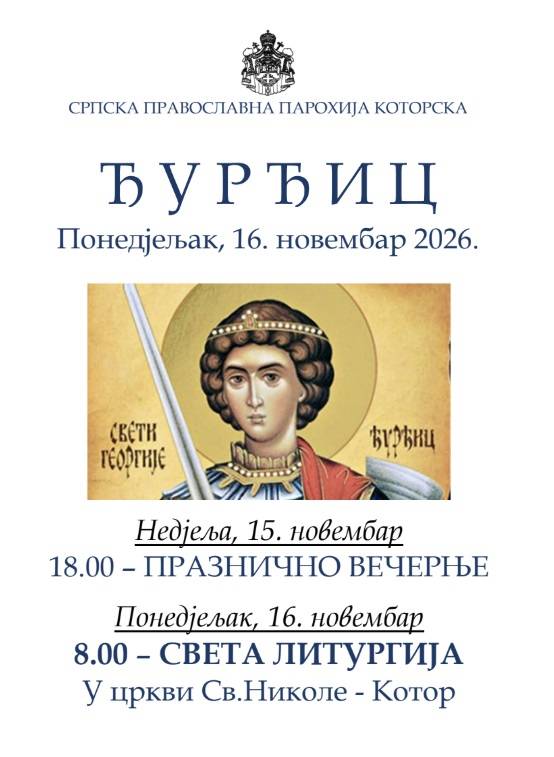
Divine Services for the Feast of the Consecration of the Church of the Holy Great Martyr...
ĐURĐIC – Monday, November 16, 2026 Sunday, November 1518:00 –...
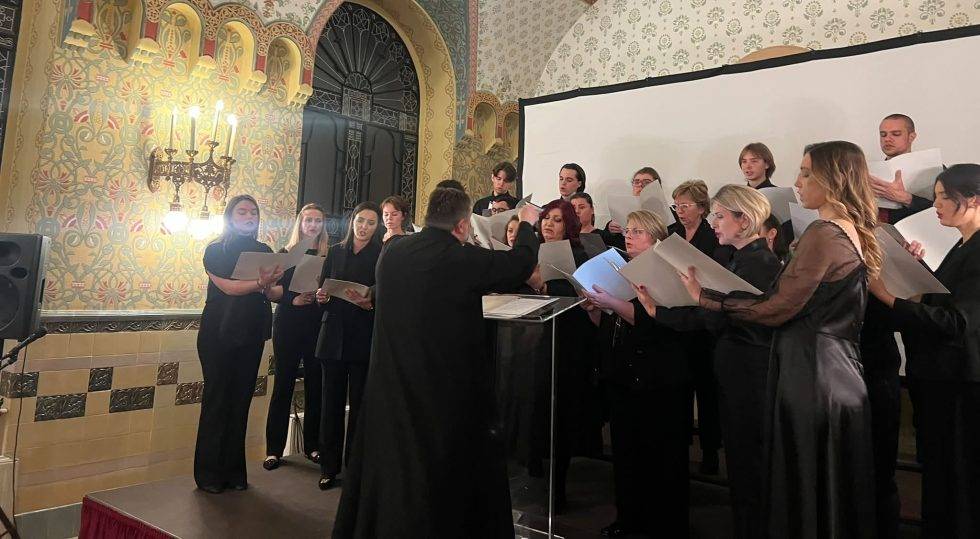
Concert by the Serbian Choral Society "Jedinstvo" from Kotor in Budapest
On November 14, 2026, a concert of sacred music was held in the ceremonial hall...
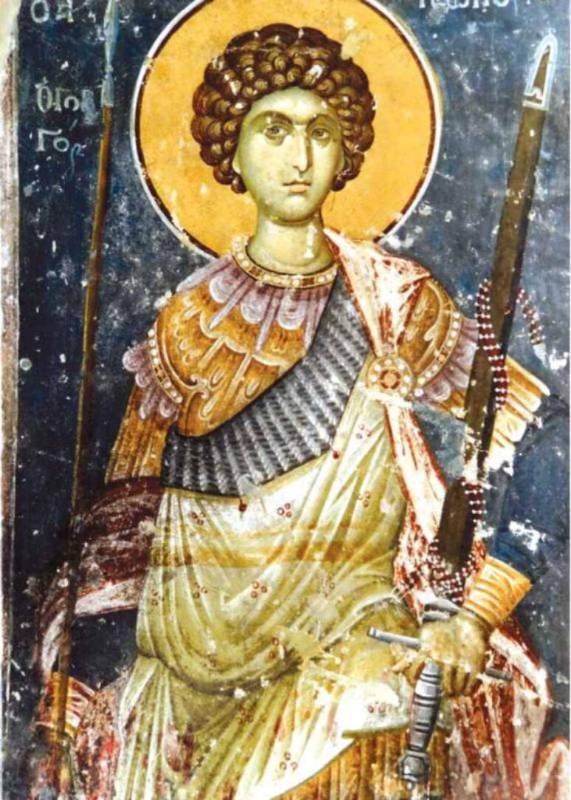
Calendar for November 16 The Dedication of the Church of the Holy Great Martyr George –...
On this day, the translation of the relics of Saint George from Nicomedia to...