THE SERIES WITNESSES OF A CENTURY ENDED WITH A DISCUSSION ON RELIGIOUS TOURISM
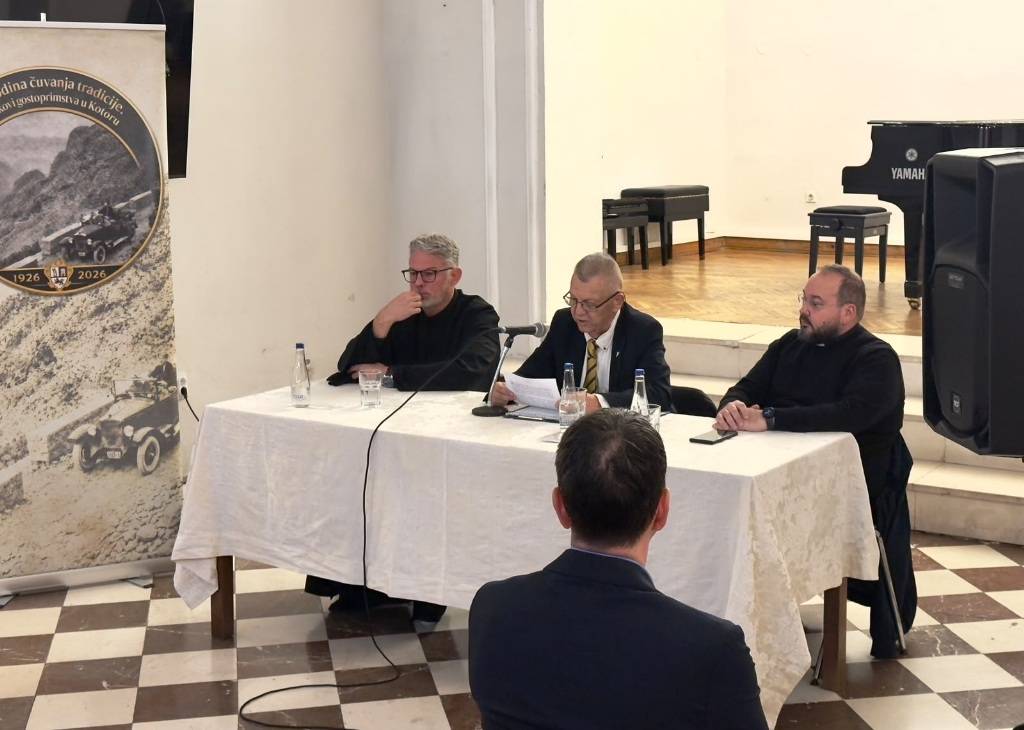
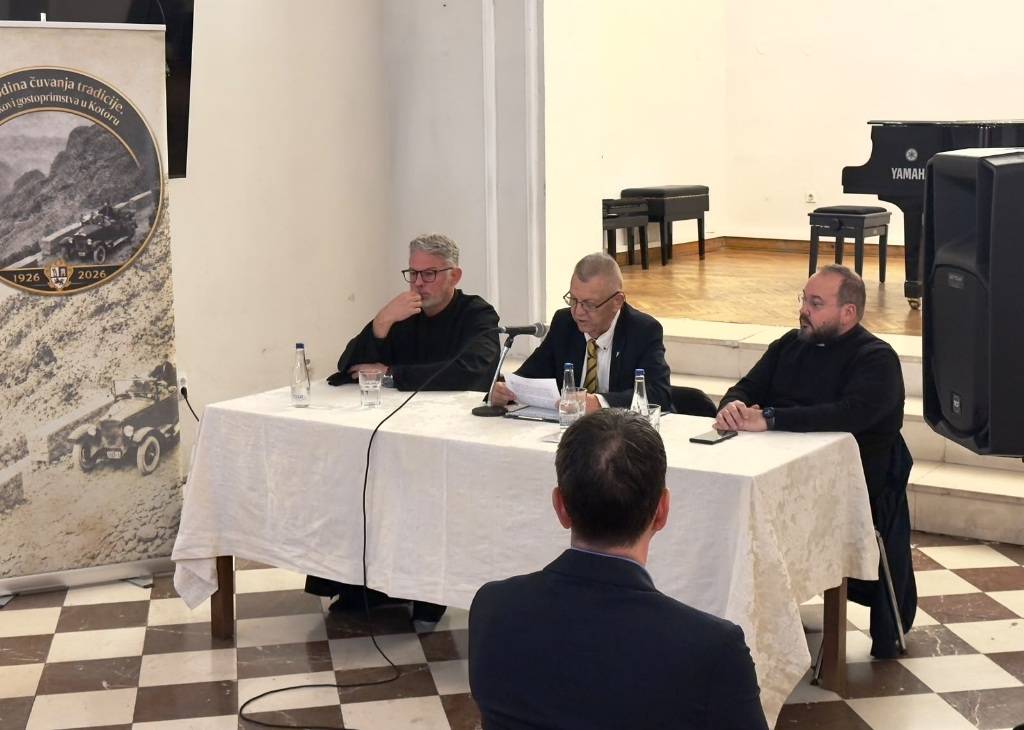
The seventh and final discussion on the topic of religious tourism in Kotor and Boka, held last night in the Church of the Holy Spirit, ended the series "Witnesses of a Century", which the Tourist Organization of the Municipality of Kotor realized as part of the celebration of 100 years of organized tourism.
The last evening of the cycle was dedicated to the spiritual and sacred heritage of Kotor and Boka, the importance of pilgrimages and religious journeys, but also the challenges of preserving the sanctity of religious buildings in a time of increasingly intense tourist development.
Mirjana Vukasović spoke on behalf of the Tourism Organization of the Municipality of Kotor, who pointed out that the topic of religious tourism was not chosen by chance to end the series, since faith and pilgrimages were among the oldest motives for travel.
"We thought it was important to round off this cycle with this topic, because long before modern tourism, organized travel, hotels and tourist societies, people traveled guided by faith, pilgrimage, vows, the need to visit shrines, find a place of prayer or encounter a space that had a special spiritual significance for them. In a way, such trips are among the oldest forms of travel in general. That is why the story of religious tourism is not isolated from the history of tourism, it is deeply embedded woven into its beginnings, and Kotor and Boka have a special place for this topic," said Vukasović.
She recalled that churches, monasteries, convents and sanctuaries shaped the identity of this area throughout the centuries, stressing that their value goes beyond tourist importance.
Those present were also greeted by the director of the Tourism Organization of the Municipality of Kotor, Jovan Ristić, who emphasized the symbolism of the final conversation, reminding them that precisely religious motives were among the first reasons for the arrival of travelers to Kotor.
"Symbolically, this evening is the last of our gathering, it closes a circle and brings us back to the beginning. Exactly as Mirjana said, we can consider that the first motives for coming to this city, for traveling in general, were related to faith and religion," said Ristić.
He thanked all the participants who during the previous months contributed to the realization of the series, and especially Mirjana Vukasović for the initiative.
The conversation, as during previous meetings, was led by journalist Dušan Davidović, who recalled the topics covered in the series, from the beginnings of organized tourism and the development of hospitality, through maritime connections and sports tourism, to Kotor carnivals and Bokeška night.
Speaking about the religious heritage of Boka, Davidović pointed to the long tradition of respecting church holidays, saints and customs that have been maintained throughout different historical periods.
"That's why we should remind you of the long tradition of observing church holidays and the religiosity of the Bokelje people, who, even in some turbulent times, remained mostly devoted to the faith they inherited from their ancestors. Saints such as Saint Tripun, who is celebrated by Catholics and Orthodox, Saint Leopold Mandić, Blessed Ozana, Blessed Gracija, and Saint Joanikije Bokeški, Saint Stefan Štiljanović Paštrovski, Saint Kirill of Đenović, Saint Mihailo from Krtol, as well as the Holy Martyrs of Prevlač," Davidović reminded.
He also reminded of religious festivities that gather believers and visitors.
"In addition to pilgrims from various countries, for church holidays, which have always been important for Bokelje, tourists also arrive in our area, whom we meet at every procession, Tripundan festivities, the Great Lady on August 15 in Perast, but increasingly also on the Lady of Mercy, the Little Lady on Prčanje, where Don Niko Luković decorated the temple with exceptional works of art. The Fašinada in Perast is particularly interesting and attractive to more and more tourists.
After the Second World War in Kotor, the tradition of the Trinity procession was not renewed, Christmas Eve is very popular, and in order to preserve the tradition of laying down the Christmas tree, Saint Basil is massively honored on May 12 in the church in Dobrota, as well as the Great Virgin on Savina, Holy Friday on August 8, the Assembly of the Virgin in Bunovići, the Little Virgin on September 21 in the Lastva monastery and other holidays that in their own way motivate citizens, tourists and pilgrims to they participate in these celebrations during their vacations," explained Davidović.
Archpriest Stavrofor Nemanja Krivokapić, archpriest vicar of Kotor-Tivat and parish priest of Kotor spoke about the importance of religious tourism, the attitude of visitors towards sacred objects and experiences of the Orthodox Church.
Krivokapić pointed out that the church festivities and the common veneration of saints are among the most beautiful examples of the preservation of tradition in Boka, especially pointing out the importance of the gathering of Orthodox and Catholic believers.
"Saint Sava is an Orthodox saint, but that is important in a place where we can really see, apart from the Orthodox, a lot of Catholic people who come to pay respect to the saint, to pray. That is something we are really proud of," Krivokapić said.
Speaking about different forms of religious travel, he explained that there are organized groups that come with the clear intention of visiting certain sanctuaries, churches and monasteries, but also numerous tourists who visit sacred buildings as part of getting to know the cultural and historical heritage of Kotor.
According to him, it is precisely this second category that is particularly represented in the city, since churches and other religious buildings make up a significant part of its most famous cultural sights.
Krivokapić also pointed to the challenges brought by a large number of visitors, especially when tourist visits take place during religious services. He emphasized that churches are not only historical monuments and tourist attractions, but above all places of prayer and spiritual life.
As he explained, even when visitors come with good intentions, their number can make it difficult for the worship service to take place, which is why it is necessary to find a balance between openness to tourists and respect for believers who participate in everyday church life.
Don Robert Tonsati, pastor of Kotor and head of the Office for Culture and Cultural Assets of the Diocese of Kotor, spoke about the historical development of pilgrimage and its connection with modern tourism.
Tonsati reminded that trips motivated by faith existed long before modern tourism and that their traces can be traced through different civilizations and cultures.
"Religious tourism, or as I would prefer to call it, pilgrimage, is actually one of the oldest and most important forms of travel, which has not only marked Christianity, but all cultures and civilizations that we know today," Tonsati explained, adding that it is important to distinguish pilgrimage, which implies a journey with a specific spiritual goal, from religious tourism, which can include a visit to a shrine, but also getting to know the culture, history and traditions of a certain area.
Speaking about the development of pilgrimage trips, he referred to the importance of the Holy Land, Rome and Santiago de Compostela, as well as the pilgrimage routes that connected different parts of Europe for centuries. According to him, such trips did not only affect the spiritual life, but also the development of cities, economy, arts and crafts.
A special part of the conversation was dedicated to the tourists and pilgrims who visit Kotor today, as well as their attitude towards the Cathedral of St. Tripun and other sacred objects.
Tonsati explained that there are big differences among visitors - from those who come primarily for the cultural and historical sights, through tourists who only discover the religious significance of the city upon arrival, to pilgrims who come purposefully to worship the powers of Saint Tripun and participate in religious life.
He pointed out that many visitors are interested in the dates of mass celebrations and the possibility of participating in religious services, but at the same time there are those who do not fully understand the importance and rules of behavior in the sacred space.
That is why, as he stated, it was necessary to establish clearer rules for visiting the Cathedral during worship, in order to preserve the peace and dignity of religious ceremonies.
Speaking about the veneration of Saint Tripun, Tonsati pointed out the great interest of believers from different countries, especially from the Orthodox tradition.
According to him, believers from Russia, Ukraine, Bulgaria, Greece and Serbia are among those who show special interest in Saint Tripun, who come to pay homage to his powers/relics, and some even leave letters with prayers.
Tonsati also referred to the need for better presentation of Kotor's sacred heritage, warning that visitors sometimes receive incomplete or incorrect information from tourist guides about the history of churches, religious customs and the life of the local community.
In the continuation of the conversation, there was also talk about the connection of spiritual and musical traditions with the tourist offer of Kotor.
On that occasion, Krivokapić spoke about the experience of church singers performing in Orthodox churches, stressing that tourists' interest in church singing contributed to the creation of programs that allow visitors to get to know this type of spiritual music outside of regular services.
He explained that the idea developed spontaneously, thanks to musically educated singers who wanted to introduce visitors to the richness of Orthodox church singing. In this way, as he pointed out, tourists get the opportunity to hear music that belongs to their living tradition during the tour of churches, and not only to get to know the architecture and artistic heritage.
They also discussed the importance of choir performances and spiritual music concerts, which connect local residents and visitors, contributing to the cultural life of the city.
Krivokapić pointed out the importance of holding concerts in church premises, whose acoustics and ambience provide a special experience of spiritual music, but also the value of outdoor programs, which allow casual passers-by to get acquainted with this tradition.
The series "Witnesses of a Century" was rounded off with the seventh conversation on religious tourism, during which various segments of the development of tourism in Kotor and Boka were illuminated through the memories, experiences and testimonies of the interlocutors.
The final topic reminded that the tourist identity of this area is not only made up of natural beauty, historical monuments and manifestations, but also spiritual heritage, religious customs and traditions of common life that have been preserved for centuries and passed on to new generations.
Mihaela Moskov
Radio Kotor
PHOTOS

RELATED ARTICLES
MEMORIAL SERVICES FOR ST. DEMETRIUS’ DAY (MITROVDAN) IN THE PARISH OF KOTOR
The Administration of the Serbian Orthodox Parish of Kotor announces the...
THE SERIES WITNESSES OF A CENTURY ENDED WITH A DISCUSSION ON RELIGIOUS TOURISM
The seventh and final discussion on the topic of religious tourism in Kotor and...
TO FORGIVE OR TO FORGET – A LECTURE BY ARCHPRIEST-STAVROPHORE DR. MILOŠ VESIN
Archpriest-Staurophore Dr. Miloš Vesin will deliver a lecture titled "To...