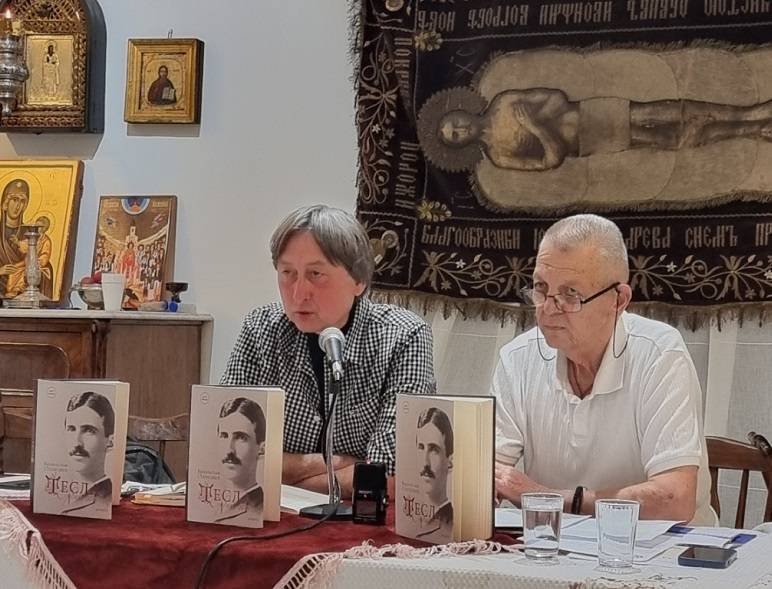
THE BOOK OF TESLA I'M A SERBIAN BY BRANISLAV STANKOVIĆ PRESENTED IN THE TREASURY OF SPC KOTOR
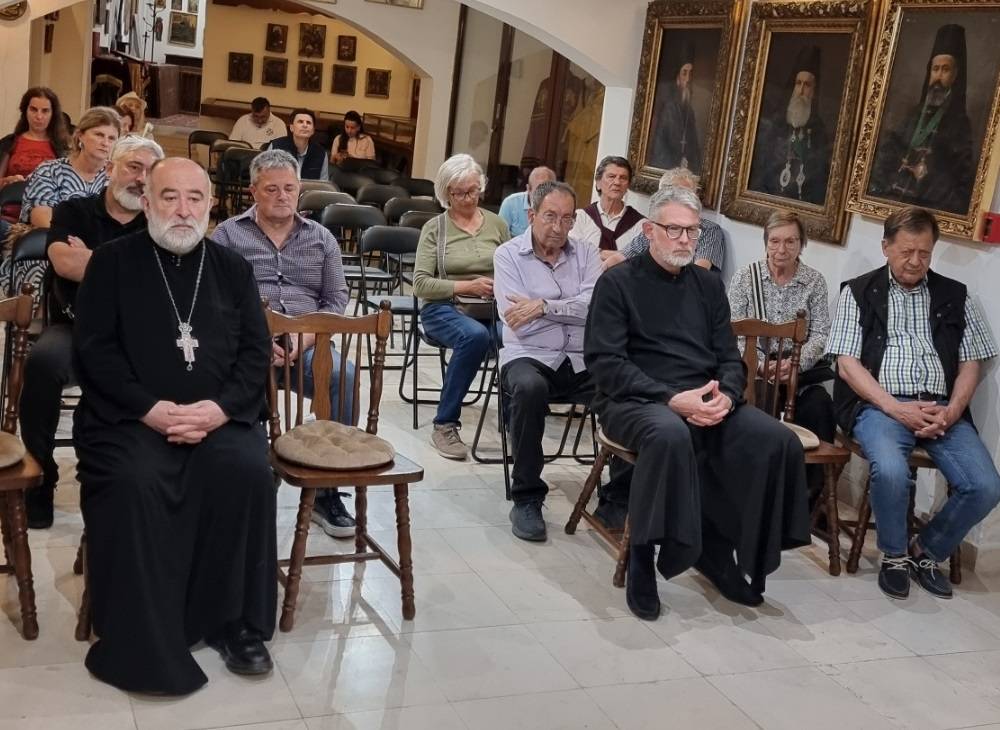
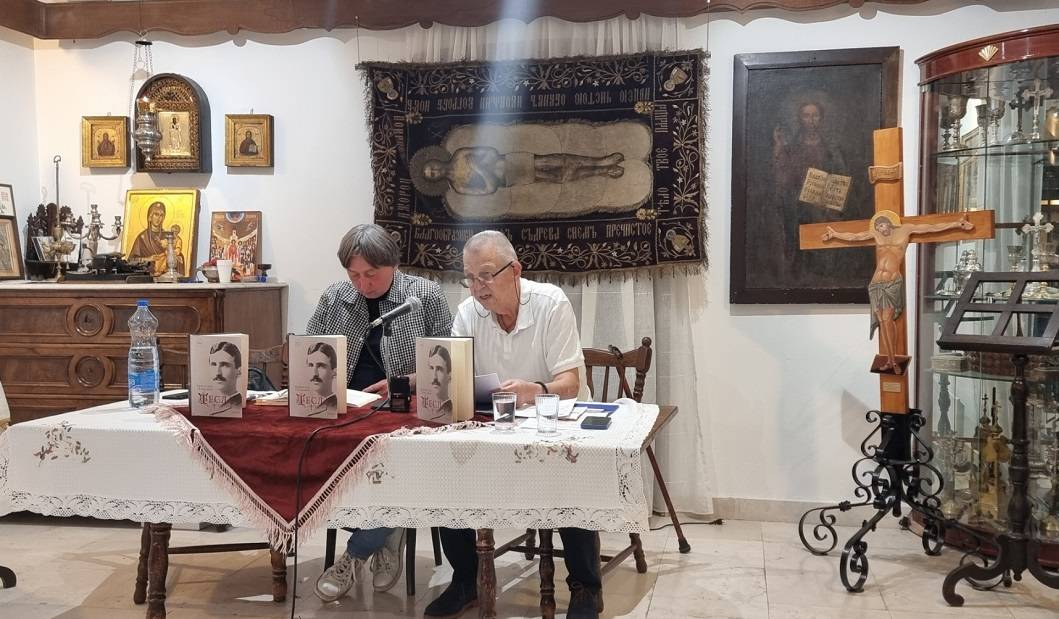
Branislav Stanković's book "Tesla I'm a Serb", which was presented yesterday in the Treasury of the Serbian Orthodox Church in the organization of the Serbian Singing Society "Jedinstvo" 1839 Kotor and the Serbian Orthodox Church Municipality of Kotor, is said to be a documentary testimony of a seemingly small but essentially important event, the defense of Nikola Tesla's identity in the academic public at the beginning of the 20th century. At the forum, the basic facts from Tesla's biography were repeated, that his father, Milutin Tesla, was a Serbian priest, his mother Đuka, also from a Serbian priestly family, but also that Tesla, unfortunately, is appropriated in some neighboring cultures.
The mediator, Dušan Davidović, also recalled a letter from the Serbian Singing Society of Kotor addressed to Tesla (kept in the Nikola Tesla Museum in Belgrade), on the occasion of the centennial celebration of the Society in 1939, of which Mihajlo Pupin was an honorary member. He also presented a little-known fact that the city of Gera (USA), where a church was built, on Tesla's recommendation, dedicated to Saint Sava, was also the birthplace of actor Karl Malden (Mladen George Sekulović), later an Oscar winner, and a relative of the president of the Serbian Orthodox Church Municipality of Kotor, Miša Sekulović.
“American journalist Kenneth Sviz wrote that Tesla was a poet of science and he truly treated life and science as a poet. There is more evidence that he spoke verses in several languages, entire collections, knew Gorski vijenac and Lord Byron by heart, Šilera,” said Stanković, adding that Tesla often delighted those present at receptions by reciting poetry, original, in several languages.
“It is interesting that Janko Veselinović, the author of the novel “Hajduk Stanko”, the work with the largest number of editions and translations in the history of Serbian literature, also met with Tesla in Belgrade. Both were sons of priests. In the fall of 1892, the first edition of the novel “Hajduk Stanko”, which Janko Veselinović dedicated to Nikola Tesla, was published. It is interesting that, when it comes to the Serbian community in Gera, one of the most important individuals and the president of the church municipality was Jovan Dučić’s own brother, Mihajlo Dučić. At that time, the Serbian church community decided to build its own temple. Mihajlo Dučić proposed that the godfather of the temple be Nikola Tesla. He accepted this and when asked to whom the temple should be dedicated, he said “to the best among us, Saint Sava”. Serbian bishop Varnava Nastić was also born in Gera. In 1927, he left Gera for the USA, came to Yugoslavia, became a monk with the support of bishop Nikolaj who "He was always in touch with Mihajlo Pupin and Nikola Tesla. After World War II, due to persecution by the newly established authorities, after several years of imprisonment and torture, he died. These are some people who are connected to Gera and connected to Nikola Tesla, connected to the Serbian Church and to Tesla's Serbness," said Stanković.
An important topic of the book, hidden at first, is the destruction of civilization around Nikola Tesla, the burned villages and churches and the genocide against Serbs in Lika and Dalmatia during the time of the NDH. At that time, many of his compatriots, surnamed Tesla, were also killed in Smiljan, the birthplace of the scientist who left the entire world in debt. Tesla, as it was heard, was not liturgical, but he was deeply religious, coming from a lineage that included 36 priests and monks. The book also contains details about the conflict between Tesla and Pupin, which was not of epic proportions, as it was presented to the public.
“Nikola Tesla comes from a priestly family. His father was Milutin Tesla. He was a serious and great national fighter for the Serbian cause in Lika. He published numerous articles in the most important Serbian newspapers in Austria-Hungary at that time in Srbobran in Zagreb, in Zvezda, Vranik, Novi Sad… He usually signed himself as Rodoljub Pravičić. And these articles were mostly related to the problems of the Serbian people that needed to be solved. One of the most important things he advocated for was the opening of schools in the Serbian language. Nikola Tesla’s mother, Đuka Tesla, also comes from a priestly family, and his great-grandmother Sofija from the Budisavljević family. They were priests and monks for generations in a long line. There are somewhere, on both sides, about 38 names that are closely related to Nikola Tesla. His uncle, Nikolaj Mandić, in secular life Petar Mandić, when his children and wife passed away, in 1891 He became a monk and became an archimandride in the Gomirje Monastery (the westernmost Serbian monastery in Europe) and a year later he became the first Serb after the dissolution of the Peć Patriarchate, the Bishop of Zvornik-Tuzla, and later the Metropolitan of Dabro-Bosnia. Nikola Tesla grew up in a completely Orthodox atmosphere. According to his own testimony, his autobiography, he says that he was with his father in church every Sunday, to help him as much as he could at his age.
Particularly interesting is the testimony of Ivan Meštrović, a famous sculptor, Croat, that in 1924, in a conversation with Nikola Tesla, which he recorded and published in his book, Tesla at One Moment, he said that he “turned to mysticism and told me on that occasion that his whole life he prays to the Lord God on his knees all night. When I asked him how he does it, he said, the way I learned in my parents’ home and that’s how it was usually until I was 50 or so. After that, he prays a little differently, but the essence is the same. Until he went to high school in Rakovac, Nikola Tesla, we can say, was liturgical, attended liturgies and lived a liturgical life, like his parents lived. However, after leaving for the world, first to Rakovac, then to Graz, Prague, Budapest, Paris, New York, he simply could no longer live a liturgical life for objective reasons, because there were no Orthodox churches in his vicinity. The first Orthodox church was built there in the first half of the "90s of the 19th century. It was built by the Greek Orthodox community. Of course, Tesla, since he did not know Greek, although he spoke five or six languages, it did not mean anything special to him," said Subotić.
He emphasizes that Tesla's closeness to the Serbian Orthodox Church was reflected in his friendship and closeness with its important prelates.
"Like, for example, your fellow countryman, here from Boka Kotorska, about whom unfortunately not much is known among the Serbian people, but who is a magnificent personality. This is Saint Sebastian Dabović. His parents left for the United States of America from the Herceg Novi area, for San Francisco, and Sebastian Dabović was the first Serbian male child born on the west coast of the USA. Already in those teenage years, he turned to the Church and first, as a layman, he went to Alaska to be a missionary. he graduated from the highest theological schools in Kiev, Petrograd and Moscow, where he became a monk. When he returned, he was sent to Alaska by the Serbs, who were engaged in mining, and built a temple dedicated to St. Nicholas in Alaska. Then, in the 1930s, he built a temple dedicated to St. Sava in Douglas. The oldest Serbian the orthodox temple in the USA is in Jackson. It was built by Saint Sevastijan Dabović. I assume you watched on YouTube, when on the eve of Christmas in a small American town guns are fired, and Vlade Divac even appeared once, and it was in that small town near San Francisco that the first Serbian Orthodox church dedicated to Saint Sava was built. Until now, not enough attention has been paid, in my opinion, to the relationship between Nikola Tesla and Saint Sevastijan Dabović. I dealt with it a little more seriously and published some letters I found, which Sebastijan Dabović sent to Nikola Tesla, where he calls him a Serbian brother and a Christian. Another significant personality of the Serbian Orthodox Church, with whom Nikola Tesla was close, is the Holy Bishop Nikolay of Ohrid and Žič. They met in 1915 when St. Nicholas went to the USA as a hieromonk, who was instructed by Nikola Pašić to help the Serbian mission and to turn American public opinion around in favor of the Serbian people. He expected great help from the two most important Serbs of that time, such as Mihajlo Pupin and Nikola Tesla. "The meeting took place in the hotel where Nikola Tesla lived, and that meeting was arranged by one of the priests of the Serbian Orthodox Church, Father Petar Stijačić," Subotić said.
Tesla first visited Belgrade and Serbia in 1892 when he heard that his mother was dying. That year, he was awarded the "Order of Saint Sava of the second order" by King Aleksandar Obrenović.
"He held several lectures and meetings and on that occasion he addressed the Serbian students with the following words: "My joy, which I feel at this moment, I cannot express to you, but I am happy that I can express before you, dear brothers, always my dearest satisfaction that I was and will always remain only a Serb and nothing more. It happens, gentlemen, that a man far from his homeland, absorbed in the work that interests me, sometimes forgets his name, his nationality and his homeland. But that, gentlemen, has never happened to me and I hope that it will never happen and can never happen. Even if I am not among you, that, like you, I do other work, I glorify the name Serbian in other ways, I work in other ways and try to, as much as I can, do something useful for my people and my dear brothers. And if there is any glory and merit for humanity to be attributed to my name, that honor belongs more to the Serbian name, to the Serbian people from whose midst I also sprang,” said Subotić, among other things, at the presentation of the book “Tesla I am Serbian”.
He also recalled that Tesla was buried according to Orthodox customs, "which also refutes some controversial stories." Namely, Tesla's nephew Sava Kosanović himself cremated his body. The urn with Tesla's ashes arrived in Belgrade in 1957. So far, several initiatives have been launched to have Nikola Tesla's remains, which were transported from America to Yugoslavia on the ship "Serbia", stored in the Temple of Saint Sava in Vračar.
Predrag Nikolić
(Radio Kotror)
PHOTOS
.png)
RELATED ARTICLES
Calendar for October 9 Saint John the Theologian, Apostle and Evangelist
The son of the fisherman Zebedee and Salome (the daughter of Joseph, the...
"Vjeronauka.me" – A New Digital Platform from the Metropolis Catechetical Board
The Catechetical Board of the Metropolitanate of Montenegro and the Littoral...
Calendar for October 8 Saint Sergius of Radonezh
A great ascetic and luminary of the Russian Church. He was born in 1313 in...